



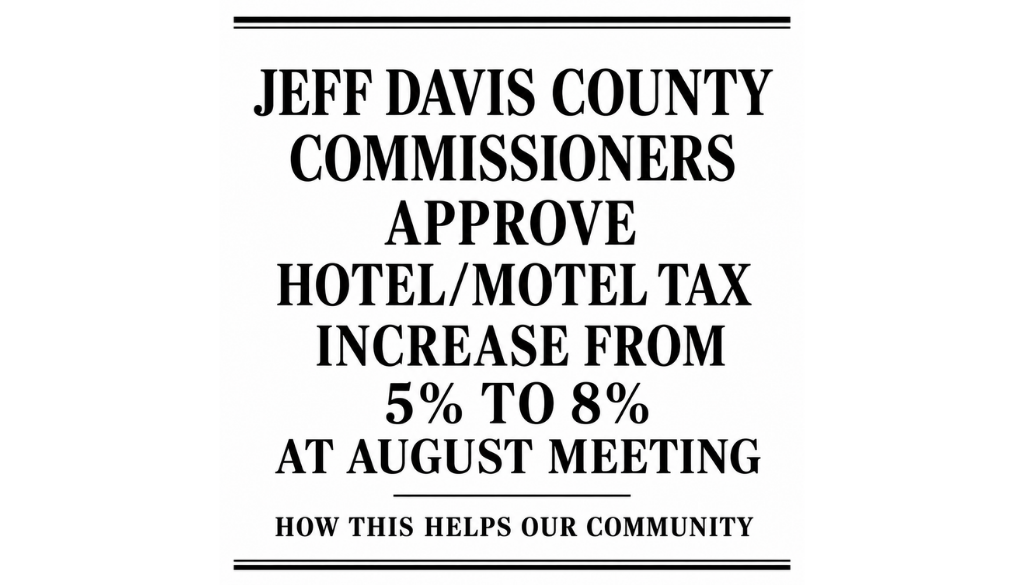
Oakley G. Perry, President/CEO of the Hazlehurst-Jeff Davis County Development Authority, recently spoke with Hazlehurst Now about why the change was pursued, how the money is collected, and how the additional revenue can be used to support tourism in Jeff Davis County. Visitors staying overnight in Jeff Davis County will soon pay a higher local hotel/motel excise tax following approval of an increase from 5% to 8%, with the new rate scheduled to take effect September 1. While the word “tax increase” naturally gets attention, this particular tax is paid by guests purchasing qualifying overnight accommodations rather than being a general tax increase on Jeff Davis County residents.

Why increase the rate? According to Perry, changes in state law allow communities to levy an 8% hotel/motel excise tax and establish a Tourism Product Development component. That provides a mechanism for tourism revenue to be used not only to promote the community, but also toward qualifying projects intended to help attract visitors.
Perry explained that tourism product development can include certain capital improvements, infrastructure, equipment and other qualifying tourism-related projects and activities. The county began the local process in December 2025, when the Jeff Davis County Commissioners approved a resolution seeking authorization to increase the tax.

One of the biggest questions surrounding the increase is what happens to the money once it is collected. According to Perry, the revenue will be divided among three tourism-related purposes.
Under the new structure, 37.5% of collections will go to the Board of Tourism, 43.75% will be designated for marketing the community, and 18.75% will go into the Tourism Product Development fund.
Based on current estimates, Perry said that breakdown is expected to generate approximately:
- Board of Tourism — $48,000
- Community Marketing — $56,000
- Tourism Product Development — $24,000
That represents an estimated $128,000 in total annual hotel/motel tax collections.
The Board of Tourism portion supports its operations and activities, including events such as Peaches to Beaches and the Three Rivers Arts Festival. Perry also said plans are underway to bring back the Steak Cookoff next summer.
The marketing portion goes to the Chamber of Commerce and is restricted for marketing the community. The Tourism Product Development fund can be used for qualifying projects designed to develop tourism opportunities and attract visitors to Jeff Davis County.
Perry emphasized that the hotel/motel tax revenue ultimately goes toward tourism-related purposes. The Board of Tourism, he noted, does not receive property tax or sales tax funding for its operations.
The tax is paid by the person staying in the qualifying accommodation, not directly by the hotel owner. For example, on a $100 hotel room, the change from 5% to 8% represents an additional $3 in local hotel/motel excise tax.
Perry said the Board of Tourism considered whether the higher rate could discourage visitors from staying in Jeff Davis County, particularly when neighboring communities may have lower rates. Ultimately, the board did not believe the additional amount would be significant enough to cause someone who planned to stay in Hazlehurst to choose lodging elsewhere solely because of the tax difference.
Jeff Davis County currently has three traditional hotels, according to Perry, along with several active Airbnb properties and other accommodations. The tax can also apply to certain nontraditional accommodations. Perry used Towns Bluff as an example: renting a regular camper space does not incur the hotel/motel tax, while staying in a yurt does.
Perry said Jeff Davis County will be somewhat of a trailblazer in the region by moving to the 8% rate. When officials compared Jeff Davis with surrounding communities, they found that neighboring counties had not yet generally moved to the same rate.
The decision, therefore, involved weighing the potential effect of a higher lodging tax against the additional opportunities the revenue could create for promoting Jeff Davis County and developing attractions and events that bring people into the community.
Moving from 5% to 8% required a multi-step process. Perry explained that officials first communicated with the Georgia Department of Community Affairs regarding the proposed change and the requirements involved. Jeff Davis County Commissioners then approved a resolution in December 2025 requesting the increase and identifying the types of tourism product development activities the additional revenue could support.
That resolution went to then-State Representative Bill Werkheiser, who introduced local legislation in the Georgia General Assembly. The legislation had to receive approval through both the Georgia House and Senate before going to Gov. Brian Kemp. Kemp subsequently signed the legislation authorizing Jeff Davis County to move forward with the increase.
However, state approval alone did not automatically raise the tax. After receiving authorization from the state, Jeff Davis County Commissioners still had to amend the local ordinance to implement the new 8% rate.
The process does not end when a visitor checks out of a hotel. Lodging establishments report and remit the tax monthly. Perry explained that the Board of Tourism provides a reporting template. Lodging providers report their total sales, any qualifying exemptions, the amount subject to the hotel/motel tax and the tax collected. The report and payment are then submitted to the Jeff Davis County Tax Commissioner’s Office.
Using August as an example, Perry said lodging providers would report activity from August 1 through August 31 and have until September 20 to submit the report and payment. The Tax Commissioner’s Office then processes the collections before the appropriate funds are transferred for tourism purposes.
Perry said officials considered having payments submitted directly to the Board of Tourism but chose to maintain the existing system, which provides another level of oversight in the collection process.
For residents, perhaps the most important distinction is that the hotel/motel excise tax is tied to overnight lodging and tourism rather than being an increase in the county’s property tax rate or general sales tax. The goal is to use dollars generated by people staying in Jeff Davis County to help promote the community, support tourism events and develop additional reasons for people to visit. Beginning September 1, the local hotel/motel excise tax will increase from 5% to 8%, opening a new source of funding for tourism product development while increasing the amount available to support and market Jeff Davis County as a destination.
