



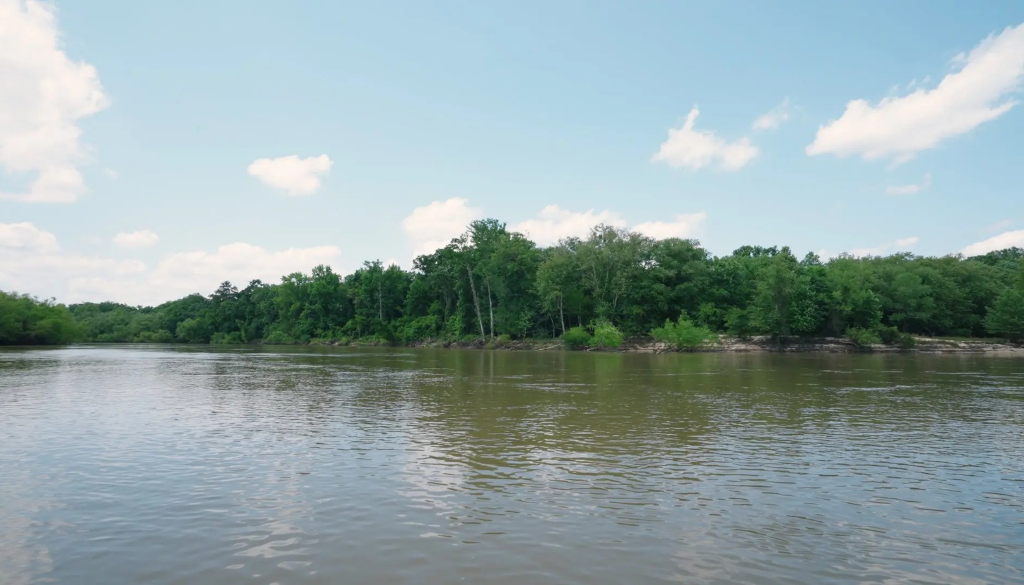
Rare discovery carries a surprising local history stretching back decades along the Ocmulgee near Jacksonville and Lumber City
TELFAIR COUNTY, Ga. — Something remarkable was hiding beneath the sand and gravel at the bottom of the Ocmulgee River. For 15 years, no one had documented a living Altamaha spinymussel — an endangered freshwater mussel found naturally nowhere in the world except Georgia’s Altamaha River basin.

Some wildlife experts had begun to wonder whether the species had disappeared altogether. Then, on July 7, Georgia Department of Natural Resources aquatic biologist Zach Schumber reached into the river bottom below Jacksonville in Telfair County and pulled up something his survey team had never seen alive before. It was an Altamaha spinymussel. The palm-sized, brown mussel, distinguished by the unusual spines protruding from its shell, was the first live member of the species documented since 2011.
Schumber and DNR technicians Percy Knight, Rachael Byrne and Gina Mondibrown weren’t actually looking for the endangered spinymussel that day. They were surveying the lower Ocmulgee below Jacksonville as part of a long-running conservation effort involving other mollusk species when they noticed an area where the river bottom looked promising. The packed sand and gravel caught their attention.

Within about 10 minutes of searching, Schumber felt a large mussel buried beneath the river bottom. According to DNR, he immediately surfaced to show the rest of the crew. The discovery was significant enough that Matt Rowe, who leads DNR’s Freshwater Biodiversity Program, acknowledged that he and other scientists had been getting close to considering the species extinct.
The mussel was measured and tagged and checked to determine whether it was carrying young. It was not. Researchers then returned it to the river and marked the location.
The Altamaha spinymussel (Elliptio spinosa) has one of the most restricted ranges imaginable. It exists naturally only within the Altamaha River basin in Georgia, historically occurring in portions of the Altamaha, Ocmulgee, Oconee and Ohoopee rivers. It was federally listed as endangered in 2011.
Its name comes from the short spines that project from its shell. The newly discovered specimen had four visible spikes, while DNR says members of the species generally have between one and five. And despite decades of research, scientists still don’t have answers to some surprisingly basic questions about it—including why it has those spines and which fish species it depends upon to reproduce and disperse its young.
Freshwater mussels also perform an important job in river ecosystems. As filter feeders, they can improve water clarity, help stabilize river bottoms and provide food for other animals. Because mussels are sensitive to contaminants and changing water conditions, their presence can also provide scientists with clues about the health of a river.
The location of the new discovery becomes even more interesting when looking back at the history of the species. The lower Ocmulgee was once considered important habitat for the Altamaha spinymussel, and federal records document populations in the same general stretch of river decades ago.
Historical surveys found spinymussels along the lower Ocmulgee and Altamaha before their numbers began declining dramatically. By the time the U.S. Fish and Wildlife Service moved to protect the species, surviving populations had become small, scattered and difficult to locate. Federal officials identified portions of the Ocmulgee—including river habitat running through Telfair and Jeff Davis counties—among areas important to the species’ survival.
The federal critical-habitat designation eventually encompassed approximately 68 miles of the Ocmulgee River, along with about 70 miles of the Altamaha and nine miles of the Ohoopee. That history makes the July discovery below Jacksonville especially significant: a species that once inhabited this part of the river, then seemingly disappeared from view for years, has been found alive here again.
The decline did not happen overnight. DNR says the Altamaha spinymussel has been declining since the late 1970s. The last live specimen documented before this summer was found in the Altamaha near Jesup in 2011—the same year the species received federal endangered-species protection. DNR says even empty shells have become difficult to find in the wild.
The U.S. Fish and Wildlife Service points to several threats, including habitat loss and modification, degraded water quality, legacy sediment from past agricultural practices and the vulnerability created by an already extremely small population. Drought, pollution events and other sudden changes can pose an especially serious threat when so few individuals remain. The species is now considered locally extinct in portions of its historical range.
Scientists are careful not to overstate what the July discovery means. Finding one living Altamaha spinymussel does not prove that a healthy, reproducing population remains in the Ocmulgee. DNR cautions that the species could still be functionally extinct, meaning there may be too few surviving animals to maintain a viable population.
But one living mussel changes something important. It gives researchers a reason to keep looking. DNR plans additional surveys, and scientists hope more individuals can be located. Finding enough could help researchers answer long-standing questions about the animal’s reproduction and potentially develop methods for propagating the mussels and rebuilding populations. The U.S. Fish and Wildlife Service’s recovery strategy ultimately calls for multiple healthy populations distributed across the species’ historical range.
For now, the little mussel found beneath the Ocmulgee represents something much larger. After 15 years without a documented living Altamaha spinymussel, a species unique to Georgia has surfaced again — in a stretch of river right here in our part of the state. And somewhere beneath the sand and gravel of the lower Ocmulgee, scientists are hoping there are more.
Sources: Georgia Wildlife Blog, U.S. Fish and Wildlife Service,
