



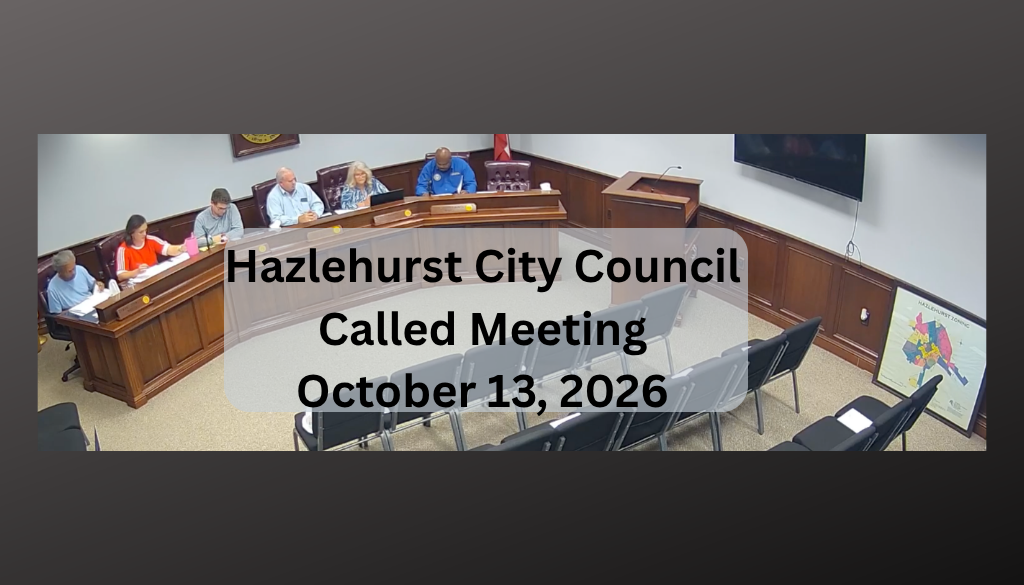
The Hazlehurst City Council voted unanimously during a called meeting on October 13 to amend the city’s general fund budget, allocating an estimated $140,444 in additional property tax revenue associated with the increase in the city’s millage rate from six to seven mills.

The council also approved establishing a budget line item for a possible future city manager position, although no funding was allocated for the position.
Much of the meeting focused on financial planning, including rising fuel costs, employee health insurance expenses, equipment needs and opportunities to reduce spending across city departments.

Council Allocates Additional Property Tax Revenue
The council voted 3–0 to approve a budget amendment distributing the estimated $140,444 in additional revenue among four categories.
| Budget allocation | Amount |
|---|---|
| Contingency fund | $120,444 |
| Downtown Development Authority (DDA) | $15,000 |
| Joint Development Authority (JDA) | $2,500 |
| Board of Tourism | $2,500 |
| Total | $140,444 |
City officials explained that the additional revenue is tied to the city’s property tax millage rate, which was increased from six to seven mills during the September council meeting. Based on figures provided to the city, officials estimated that the additional $140,444 would bring total potential city property tax revenue for 2026 to approximately $981,305. The figures were described as estimates rather than final collections.
Officials emphasized that property tax revenue goes into the city’s general fund and is separate from the water and sewer budget. The largest portion of the amendment, $120,444, was placed into a contingency fund. Council members discussed using the fund to address unforeseen expenses, particularly rising fuel costs and other operational needs. Officials explained that money placed in contingency cannot simply be spent at a department’s discretion. Any transfer would require review and approval by the council.
The $15,000 allocation to the Downtown Development Authority provides funding for downtown development efforts. Council members also discussed the roles of the Joint Development Authority and Board of Tourism before agreeing to allocate $2,500 to each organization. During the discussion, officials clarified that the Board of Tourism is assisting the city with cemetery mapping, including plans for printed maps and online access.
The approved amendment also included a proposal from Councilman Christopher Jones to establish a city manager line item in the general fund budget. Jones explained that he wanted the category created for possible consideration in a future budget. He emphasized that the proposal did not include funding for a city manager.
The council approved adding the line item with a $0 allocation. The action does not authorize hiring a city manager or establish a salary for the position. Any future funding would require additional consideration.
Although the council previously voted to increase the millage rate to seven mills, officials explained that additional public hearings and formal adoption procedures were still required.
The following schedule was announced during the meeting:
- Wednesday, October 14, at 10:30 a.m. — Public hearing
- Wednesday, October 14, at 6 p.m. — Public hearing
- Thursday, October 15, at 4:30 p.m. — Public hearing
- Thursday, October 22, at 5:30 p.m. — Called council meeting for formal adoption
Officials said property tax bills were expected to be mailed by the end of October.
Another significant discussion involved the increasing cost of health insurance for city employees. City officials reported that Hazlehurst currently pays the health insurance premiums for its employees, at an estimated annual cost of approximately $900,000.
The city has begun reviewing insurance quotes for the upcoming coverage period. Officials described the initial renewal figures as substantially higher than current costs, with one quoted amount approaching $2,000 per employee. Additional quotes are being requested.
During the discussion, officials raised the possibility that employees could eventually be asked to contribute toward their health insurance premiums. Council members acknowledged that employer-paid health insurance is an important benefit that helps the city recruit and retain employees. Police officials specifically noted the importance of insurance benefits in retaining officers.
Council members also discussed the relationship between insurance expenses, future employee raises and the city’s overall compensation package. No changes to employee health insurance coverage or employee contributions were approved during the meeting. Officials indicated that the issue would return for further discussion once additional pricing information becomes available.
City officials urged department heads to carefully monitor spending as fuel and operating costs continue to fluctuate. Recommendations included evaluating whether equipment can be repaired rather than replaced, maintaining accurate inventories and documenting purchases and expenses.
The city is also making changes to its fuel purchasing procedures. Officials reported that the county had requested that the city find another location for fuel purchases. The city is transitioning to Hall Oil Company, where employees will be required to obtain receipts documenting fuel purchases. Those records will be used to reconcile purchases with invoices and provide greater accountability. Officials emphasized that fuel costs could place additional pressure on departmental budgets.
During a review of department expenses, Jones discussed projected savings in electricity costs at city water facilities. He reported that electricity expenses at the water treatment plant were running approximately $540 per month below the amount anticipated in the budget. He also cited potential annual electricity savings of approximately $30,000 at the Pine Street well, based on current operating expenses.
Jones suggested that savings in certain areas could help offset increased operating costs elsewhere. However, officials emphasized that water and sewer finances are maintained separately from the city’s general fund. The figures discussed were projections based on spending trends, not final year-end savings.
Council members also reviewed several departmental equipment and vehicle expenses. The Street Department is updating its equipment and vehicle records to reflect items that have been sold, removed from service or added to the fleet.
Fire Department expenses were also discussed, including a recent repair involving a fire engine.
Police officials reported that a 2020 Chevrolet Tahoe that had been totaled would be removed from the department’s vehicle records. The department does not currently plan to purchase another vehicle specifically to replace the Tahoe. Officials also discussed the possibility of using insurance proceeds for other department needs, including improvements to the police department’s air-conditioning system. The Police Department is additionally reviewing the need to replace aging computers.
The police chief said some of the department’s computers have been in service for years and may require upgrades. Officials are exploring whether available restricted or designated funds could be used for qualifying technology expenses rather than placing the entire cost on the general fund. No specific computer replacement expenditure was approved during the meeting.
Council members also discussed possible equipment leasing arrangements for the Street Department. Officials explained that eligible capital equipment leases may be paid using SPLOST funds, depending on the arrangement.
Throughout the meeting, council members emphasized the importance of monitoring department budgets and preparing for expenses that could arise before the end of the fiscal year. The discussions highlighted several financial considerations facing the city, including fuel prices, insurance costs, equipment maintenance and employee benefits.
The council’s primary action during the October 13 called meeting was approval of the $140,444 general fund budget amendment, along with the creation of an unfunded city manager budget line item.
