



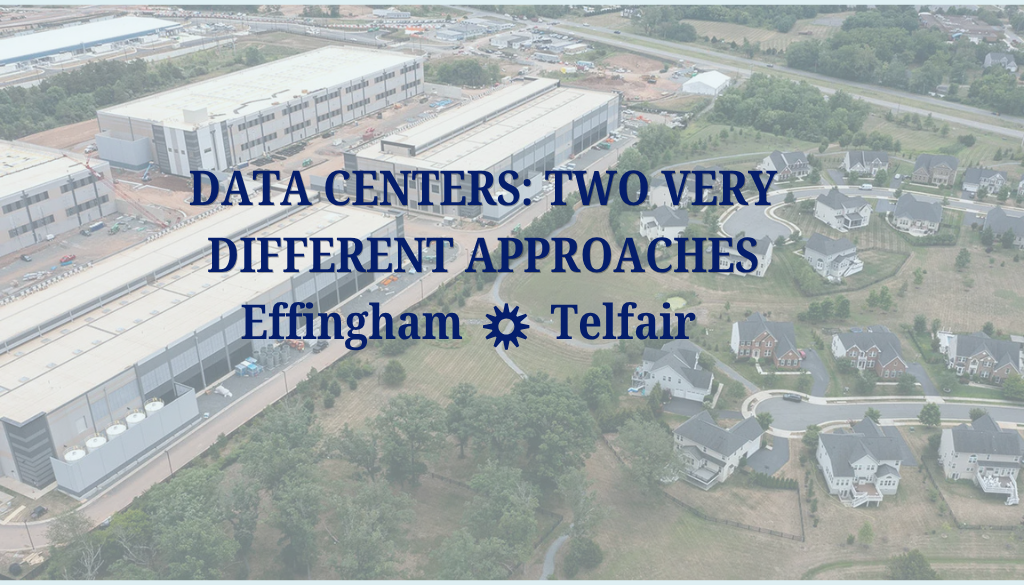
Effingham County faces a lawsuit over the process behind a $20 billion project, while Telfair County considers detailed regulations before a project arrives
As Jeff Davis County officials continue studying how to regulate potential data center development, two other South Georgia counties are providing very different examples of how communities are confronting the rapidly growing industry.

In Effingham County, a group of residents and the conservation organization One Hundred Miles filed a lawsuit Monday challenging the process used by the Effingham County Industrial Development Authority as it advanced a proposed $20 billion OpenAI data center campus.
About 100 miles to the west, Telfair County is taking a different path. Commissioners there are considering a proposed data center ordinance that establishes detailed requirements involving public meetings, water use, cooling systems, noise, environmental review, setbacks, emergency response and financial incentives before a future project could move forward.

The situations are not directly comparable. Effingham County already has a specific multibillion-dollar project under consideration, while Telfair County officials have said their ordinance is intended to establish rules before such a development arrives.
But together, the two counties illustrate some of the questions communities across Georgia are confronting as large-scale data center development expands — questions that are now part of the conversation in Jeff Davis County as well.
Effingham: $20 Billion Project Followed by Lawsuit
Effingham County officials announced July 22 that OpenAI plans to establish a data center campus within the Savannah Gateway Industrial Hub near Rincon. According to the Effingham County Industrial Development Authority, the project represents a planned investment of at least $20 billion and is expected to create approximately 400 permanent jobs. (Effingham Industry)
County officials have promoted the project as an economic development opportunity that could substantially increase local revenues, support schools and infrastructure and provide property-tax relief. The county has said revenue from the project would begin in 2027 and increase as the campus is built in phases. (Effingham County)
But the process used to reach the agreement is now being challenged in court.
The Southern Environmental Law Center filed suit Sept. 21 on behalf of five Effingham County residents and One Hundred Miles. The lawsuit alleges that the Effingham County Industrial Development Authority violated Georgia’s Open Meetings Act and Open Records Act while negotiating and approving agreements connected to the project. (Southern Environmental Law Center)
Among the allegations is that the project appeared on a July meeting agenda under the name “Project Gateway” without identifying the proposed data center or the tax arrangement being considered. The plaintiffs also challenge the timing and notice surrounding a rescheduled meeting and the process used for the sale of publicly owned property to Octans Georgia LLC, an OpenAI affiliate. (Southern Environmental Law Center)
The plaintiffs are asking a judge to enforce Georgia’s open-government laws and challenge agreements associated with the project. The allegations have not been adjudicated, and the filing represents the plaintiffs’ account of the events. The Effingham County Industrial Development Authority told Georgia Recorder that it “respects the legal process and will carefully review the allegations once it receives formal notice.” (Georgia Recorder)
Effingham County has also emphasized that the project still must go through additional county and state reviews and permitting before construction and operation. Those reviews include issues involving water and sewer service, stormwater, wetlands, utilities, buffers, erosion control, building requirements and fire safety. (Effingham County)
Telfair: Writing the Rules Before a Project Arrives
Meanwhile, neighboring Telfair County is considering a much different scenario. As Hazlehurst Now previously reported, Telfair County commissioners recently held the first public hearing on a proposed ordinance designed specifically to regulate data centers. HN has now obtained a copy of that proposed ordinance, providing a more detailed look at the requirements being considered.
The draft establishes different classifications for data centers, including a “Major Data Center” designation for a facility or campus with an aggregate electrical demand of five megawatts or greater at full buildout. Those larger projects would be subject to additional technical, infrastructure, water-resource, public-safety and financial reviews.
Applicants would be required to obtain a business license and pay a $15,000 application fee for each data center, along with a professional-review escrow deposit of at least $50,000.
One of the more notable provisions involves tax incentives.
The draft requires an applicant to state under oath that it and its successors will not seek a tax abatement, payment-in-lieu-of-taxes arrangement, tax incentive or other tax reduction from Telfair County or a county-related authority for the proposed development.
That creates a notable contrast with Effingham County, where the financial arrangements associated with the OpenAI project are among the issues raised in the lawsuit.
Public Meetings Before Development
Telfair’s proposed ordinance also places significant emphasis on public notification. An applicant would have to conduct three community meetings within Telfair County to describe the project, including site plans, water management and a viewshed analysis.
Those meetings would have to be advertised in advance in a newspaper of general circulation, and signage would have to be placed around the proposed property informing the public of the potential data center. Application materials would also be made available for public review.
The provision stands out in light of the Effingham lawsuit because public notice and the opportunity for residents to participate are at the center of the plaintiffs’ allegations there.
That does not establish that Telfair’s proposed process is legally preferable or that Effingham violated the law. Those are separate circumstances, and the Effingham allegations will ultimately be decided through the legal process.
Water, Cooling and Environmental Review
Telfair’s proposed ordinance also addresses one of the issues that has generated considerable discussion around data centers in Georgia: water.
The draft defines closed-loop cooling and specifically prohibits open-loop systems for liquid cooling and ventilation equipment.
Applicants would also have to provide an environmental impact assessment examining potential effects on water resources, air quality, ecology, archaeology and cultural or historical resources. The assessment would have to be prepared by an independent third party rather than the applicant or a governmental entity.
The draft calls for monthly water, soil and air-quality testing by a certified environmental specialist, with public notice of the results.
Noise, Buffers and Emergency Response
The ordinance goes beyond water. It proposes limits on continuous noise generated by a data center, including a standard of no more than 35 decibels measured 25 feet from the property line. Backup-generator testing would be restricted to specified daytime hours.
The proposal also contains landscaping, screening, fencing and setback requirements intended to separate large facilities from neighboring properties and roads. Emergency response receives considerable attention as well.
The data center operator would be required to coordinate with the Telfair County EMA director or another designee for specialized training before the facility opens. The operator would reimburse the county for specialized training and necessary equipment associated with the facility. Annual coordination with firefighters, EMS, law enforcement, hazmat and emergency-management personnel would also be required.
The draft also says no primary on-site power generation would be permitted, although emergency backup generation would be addressed separately.
Two Counties, Two Different Points in the Process
There is an important distinction between what is happening in the two counties.
Effingham County has an identified developer, a proposed $20 billion project and negotiated financial arrangements. The county and development authority argue the project will produce significant economic benefits, including jobs, new revenue and property-tax relief. (Effingham Industry)
Opponents challenging the process argue residents should have received more information and an opportunity to participate before key agreements were reached. Those allegations are now before a court. (Southern Environmental Law Center)
Telfair County, by contrast, has not publicly identified a specific data center proposal. County officials said during the recent public hearing that the ordinance is intended to put rules in place in advance.
The Telfair ordinance remains proposed. Its provisions could change as it moves through the county’s process.
Why It Matters in Jeff Davis County
The developments in both counties come as Jeff Davis County conducts its own examination of data center development.
Jeff Davis County currently has a temporary moratorium on data centers, and County Administrator Jayme Crosby recently said county and municipal officials are working together to research the issue and consider what additional regulations may be appropriate.
At the Chamber of Commerce’s recent State of the Community panel, Crosby said the goal is to examine the “good, bad and ugly” of data center development before bringing information back to the community.
That makes the experiences of neighboring and nearby Georgia counties particularly relevant.
Effingham County illustrates the disputes that can emerge when residents question how decisions surrounding a major project were made. Telfair County illustrates the kinds of requirements another rural South Georgia county is considering before a project has been publicly proposed.
Neither provides a blueprint for Jeff Davis County.
But together, they highlight many of the questions local officials and residents may have to consider: How much information should be available before an agreement is reached? What opportunity should the public have to participate? What rules should govern water, noise, power and emergency services? What financial incentives, if any, should be available? And should those rules be established before a developer comes to the table?
Those are questions communities across Georgia are increasingly being asked to answer — and they are now part of the conversation here at home.
