










As discussions about data centers continue in Jeff Davis County, residents have heard plenty about what these massive developments could bring — investment, tax revenue, construction activity and jobs. But perhaps one of the most useful ways to evaluate those possibilities is to look beyond projections and ask a simpler question: What has actually happened in communities where data centers are already operating?


The answer is not entirely good or entirely bad. Research and real-world examples show that data centers can provide substantial financial benefits to host communities. They also show that the size of the investment announced by a developer doesn’t necessarily tell residents how much money will ultimately reach their local government, how many permanent jobs will remain after construction, or what costs the community may assume.
Fayetteville: Big Potential — And a Decision to Stop at What They Have
Fayetteville, Georgia, provides an interesting example. The city is home to a massive QTS data center campus. According to the City of Fayetteville, the campus is planned to eventually include 13 buildings totaling approximately 6.2 million square feet. The numbers associated with its full buildout are impressive. QTS project estimates cited by the city project $150 million to $200 million annually in real-property tax revenue, approximately $170 million in sales-tax revenue and several hundred ongoing operational jobs. But there is an important distinction: those are project estimates for the completed development, not current annual tax collections. What can already be documented is that QTS has become a significant local taxpayer. Fayette County’s 2025 financial records listed QTS Fayetteville LLC with approximately $32 million in taxable assessed value, placing it among the county’s largest property taxpayers.
And Fayetteville has made another noteworthy decision. In March 2026, the city prohibited additional data centers in all of its zoning districts. That does not establish that Fayetteville considers its existing data center unsuccessful. It does demonstrate something important for communities considering these developments: a data center can provide economic benefits while local leaders simultaneously decide there should be limits on additional development.
City of Fayetteville Data Center Information
Stanton Springs: Money Has Actually Reached Local Governments
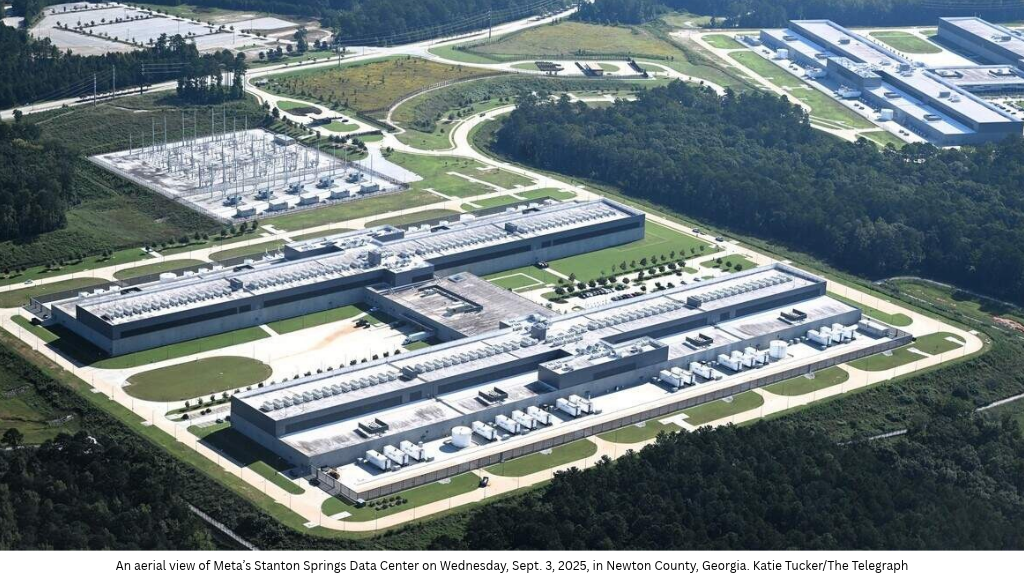
A Georgia example with more established financial results can be found at Stanton Springs, the large development spanning portions of Newton and Walton counties. Meta operates two data center campuses there. Newton County economic development officials report the Meta operation supports more than 200 jobs and represents approximately $1 billion in investment. More importantly for this discussion, there is documentation showing money flowing back to participating local governments. Stanton Springs is operated through a Joint Development Authority involving Newton, Walton, Morgan and Jasper counties. By the end of 2025, the development had generated more than $54 million distributed among the four counties, with Newton County receiving approximately $20 million. That total includes revenue from more than just Meta — including PILOT payments from Meta and Rivian and property taxes from Takeda — so it would be misleading to attribute the entire amount to the data centers. However, Joint Development Authority records show that Meta alone was scheduled to make a $5 million payment in lieu of taxes, or PILOT payment, in 2025. That’s an important distinction.
Rather than focusing solely on the enormous value of the development, residents can look at money local governments are actually receiving.
Stanton Springs Joint Development Authority
What About a Small Rural County?
For Jeff Davis County, examples from rapidly growing metropolitan areas only tell part of the story. Research released by Georgia Tech in July found that communities hosting data centers experienced economic gains overall, but researchers found those benefits were much stronger in metropolitan areas. According to the research, non-metro counties did not experience the same measurable increases in employment and new businesses that metro counties did.
That doesn’t mean rural communities cannot benefit. It suggests the benefits may look different — potentially coming more from tax revenue and negotiated payments than from large numbers of permanent jobs or surrounding business growth.
A particularly interesting comparison comes from Morrow County, Oregon, a rural county with a population much closer to the scale of Jeff Davis County. Amazon Web Services operates multiple data centers there. An Associated Press investigation reported that Amazon paid approximately $34 million in property taxes and negotiated fees in one year, even while receiving approximately $66 million in tax exemptions.
Those payments produced tangible community benefits. AP reported that money connected with the development helped provide a ladder fire truck, a school resource officer, police body cameras and assistance for homebuyers, among other uses. Amazon subsequently reported paying $54.2 million in property taxes, fees and other payments in eastern Oregon during 2024. Because that number comes from Amazon, it should be viewed as a company-reported figure rather than an independently calculated total.
The Morrow County example also illustrates why the details of an agreement matter. County records show that certain agreements provided Amazon substantial property-tax exemptions while requiring negotiated payments tied to its data centers. In other words, the tax break did not necessarily mean the company paid nothing. The community negotiated another way of receiving revenue.
A billion-dollar investment isn’t a billion-dollar benefit. That’s perhaps the biggest lesson from looking at communities that already have data centers. When a company announces a multibillion-dollar investment, that figure represents what the company expects to invest in its project. It does not mean the local government receives anything close to that amount.
To understand the actual economic benefit, residents need additional information: How much property will be taxable? What tax abatements or exemptions will the company receive? Will there be guaranteed PILOT or community-benefit payments? How many jobs will remain after construction ends? And who will pay for roads, electrical infrastructure, water systems or other improvements necessary to serve the facility? Those questions can substantially change the financial picture.
Another issue communities across the country have confronted is the use of non-disclosure agreements, commonly called NDAs, during data center and economic-development negotiations. An NDA is not automatically evidence that something improper is occurring. There can be legitimate reasons for temporary confidentiality, including protecting proprietary company information, sensitive land negotiations or information that could put a company at a competitive disadvantage.
The concern arises when confidentiality prevents citizens from obtaining information they need to understand the commitments their government may ultimately make. For a development that could affect a community for decades, residents may reasonably want to know the project’s anticipated resource demands, infrastructure requirements, tax incentives, expected permanent employment and what financial obligations could fall on local government.
The World Resources Institute has identified limiting the use of NDAs, transparent siting criteria and public disclosure of resource demands among measures communities can consider when developing policies for data centers. The issue, therefore, isn’t necessarily whether an NDA exists. The bigger question is what information is being withheld, why it must remain confidential, and whether residents will receive enough information to evaluate the project before binding decisions are made.
World Resources Institute Data Center Research
Promises vs. Results
The experiences of existing data center communities suggest there is no single answer to whether these developments are economically good or bad.
Fayetteville has a major development and significant projected tax benefits, while deciding not to permit additional data centers.
Stanton Springs provides evidence of actual multimillion-dollar payments flowing to participating counties and more than 200 reported Meta jobs.
And Morrow County, Oregon demonstrates that even a small rural county can receive substantial revenue from data centers — while also showing why tax exemptions and the agreements negotiated in exchange for them deserve close examination.
Georgia Tech’s research adds an important warning for rural communities: the broad economic ripple effects seen in metropolitan counties may not automatically happen in smaller, non-metro areas. For Jeff Davis County, perhaps the most important lesson from communities that already have data centers is this:
Don’t judge a proposal solely by the size of the investment being announced. Look at the agreement — and eventually, look at the results.
A data center can bring significant economic benefits. Whether those benefits ultimately reach the community depends heavily on what is negotiated, what costs the community assumes and how much information residents have before the decisions are made.
Sources & Further Reading
This article draws on information from the City of Fayetteville and Fayette County financial records; the Joint Development Authority of Jasper, Morgan, Newton and Walton Counties; Newton County economic-development information; Morrow County, Oregon public records; reporting by The Associated Press; research from Georgia Tech’s Scheller College of Business; and the World Resources Institute.


