



As Jeff Davis County continues discussions surrounding potential data center development, much of the conversation has centered on water use. But another major consideration is the enormous amount of electricity required to operate data centers — and whether the costs of meeting that demand can ultimately affect residential power bills. An October 2025 report from the Pew Research Center examined the rapidly growing electricity demands of data centers across the United States and the potential effects on the nation’s power grid and consumers.

How much electricity do data centers use? According to Pew, citing estimates from the International Energy Agency (IEA), U.S. data centers consumed approximately 183 terawatt-hours of electricity in 2024, accounting for more than 4% of all U.S. electricity consumption. That demand is projected to increase substantially.
By 2030, data center electricity consumption is projected to reach approximately 426 terawatt-hours — an increase of 133% from 2024 levels. AI-focused facilities can be particularly energy intensive. Pew reports that a typical AI-focused hyperscale data center can consume as much electricity annually as approximately 100,000 households. Some of the larger facilities currently under construction are expected to consume considerably more.

Most of that electricity — about 60% on average — powers the servers that process and store information. Cooling systems are another major source of electricity consumption because servers generate significant heat and must be kept at safe operating temperatures.
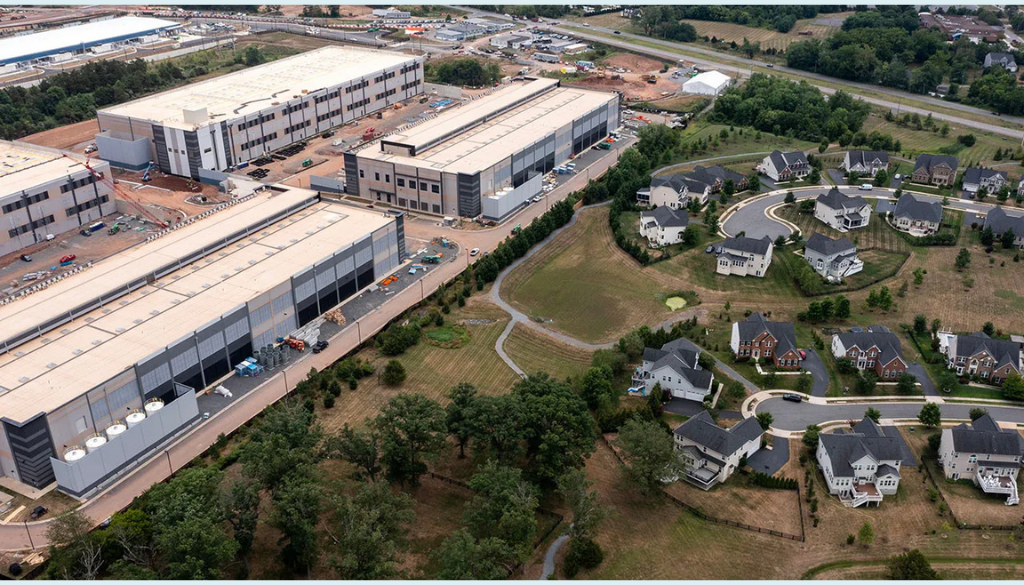
The local impact can be much larger. Although data centers account for a relatively small percentage of total electricity use nationwide, the picture can look dramatically different in communities where multiple facilities are concentrated. Pew reports that data centers accounted for approximately 26% of Virginia’s electricity supply in 2023. They also represented significant portions of electricity consumption in North Dakota, Nebraska, Iowa and Oregon.
That concentration is important because adding extremely large electricity users can require utilities to expand generation capacity and make costly improvements to transmission lines, substations and other portions of the electrical grid.
Could consumers end up paying more? This is where the issue becomes particularly relevant to homeowners and businesses. According to Pew, utilities may need to make expensive grid upgrades to accommodate the additional electricity demand created by data centers. Without protections that assign those costs to the large electricity users creating the additional demand, households and smaller businesses can potentially bear some of those costs through their electricity rates.
Pew points to the PJM electricity market, which serves a large portion of the eastern United States, as one example. Data center growth was estimated to contribute to a $9.3 billion increase in capacity-market prices for 2025-26. Pew reported that residential customers in some areas were consequently expected to see monthly bills rise by approximately $18 in western Maryland and $16 in Ohio.
A Carnegie Mellon University study cited by Pew estimated that growth from data centers and cryptocurrency mining could contribute to an approximately 8% increase in the average U.S. electricity bill by 2030, with substantially larger increases possible in some high-demand markets. Those figures are projections and examples from other electricity markets — not predictions of what Jeff Davis County residents would pay if a data center were developed locally.
Who pays for the infrastructure? That distinction may be one of the most important questions for communities considering data center development. A data center’s electricity consumption alone does not determine whether residential customers’ bills will increase. How utilities structure rates and who is required to pay for new infrastructure needed to serve large-load customers can make a significant difference. Several states have already considered policies intended to protect existing ratepayers from costs associated with rapidly expanding data center electricity demand.
For Jeff Davis County, that raises questions worth asking before any proposed development moves forward: How much electricity would a particular facility require? Does the existing electrical infrastructure have enough capacity? What upgrades would be necessary? And most importantly for existing customers, who would pay for those upgrades?
The data center industry has become an increasingly important part of the nation’s digital infrastructure, supporting cloud computing, streaming services, banking, healthcare, artificial intelligence and many other technologies used every day. But, the rapid expansion also means communities are beginning to examine not only the economic opportunities associated with data centers, but the demands they place on electricity, water and other infrastructure.
As Jeff Davis County considers the potential advantages and concerns surrounding data center development, understanding those infrastructure requirements — and determining who ultimately bears their cost — will be an important part of the conversation.
Source: Pew Research Center, October 2025, with data and research cited by Pew from the International Energy Agency, Electric Power Research Institute, U.S. Energy Information Administration, Carnegie Mellon University and other sources. Read full report.
