



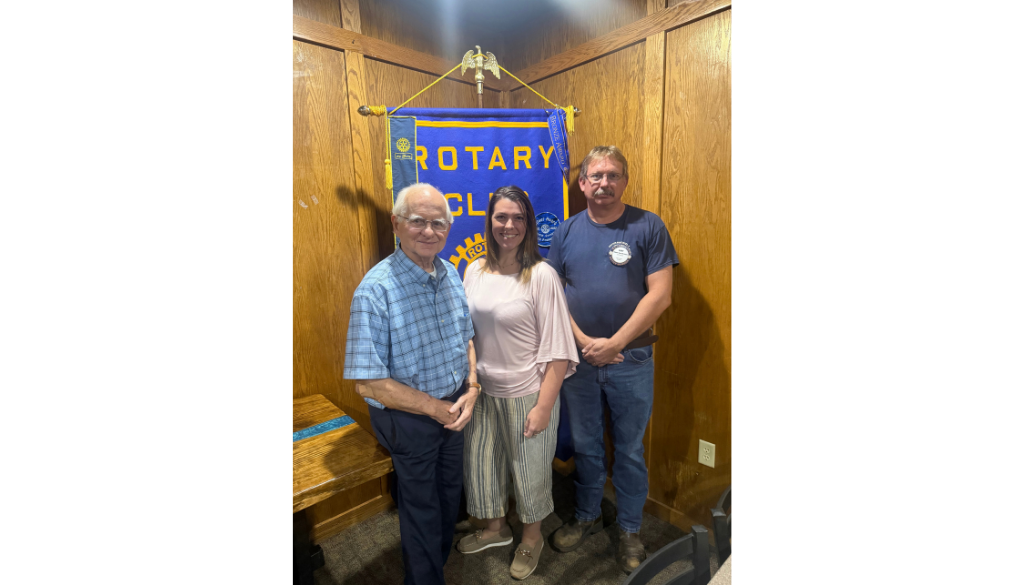
Most consumers probably don’t give much thought to the inspections, documentation and safety procedures behind the food they purchase at the grocery store. At Wednesday’s Hazlehurst Rotary Club meeting, Gary Evans introduced guest speaker Kimberly Gombert-Marlow, who gave members a behind-the-scenes look at the food production process and the safeguards designed to help keep food safe from the farm or processing facility to the consumer’s table.

Gombert-Marlow, who now works at South Georgia Cotton Gin here in Jeff Davis County, brought years of experience in food safety to the discussion. Her background includes work with the USDA Food Safety and Inspection Service at a poultry processing facility in Missouri, developing a food safety program for a hydroponic greenhouse in Athens and later establishing a food safety program at Pilgrim’s rendering facility in Douglas.
Kim explained that two primary federal agencies divide much of the responsibility for overseeing the nation’s food supply. The USDA oversees areas including meat and poultry, while the Food and Drug Administration regulates much of the remainder of the food supply, including produce, dairy, seafood, beverages and packaged foods.

Even that division has some unusual exceptions. For example, Kim explained that shell eggs fall under FDA regulation, while certain egg products fall under USDA oversight. Catfish is another exception, falling under USDA authority rather than the FDA oversight that generally applies to seafood.
But government inspectors aren’t standing over every step of production. A major theme of the presentation was that modern food-safety regulation places significant responsibility on the producer to identify potential hazards before something goes wrong.
She introduced Rotarians to HACCP — Hazard Analysis and Critical Control Points, a system used by food producers to identify where biological, chemical or physical hazards could enter the production process. Biological hazards can include bacteria such as E. coli, Salmonella or Listeria. Chemical hazards could involve cleaning chemicals or residues, while physical hazards could include materials such as glass, wood or other foreign objects.
Producers must identify those risks, establish procedures to control them and be able to document that the safeguards are actually being followed. And simply saying a process is safe isn’t enough. If a company determines that cooking a product at a particular temperature for a certain amount of time will control a hazard, Kim explained, there must be credible scientific or historical evidence supporting that decision.
Documentation was another major point of the presentation. Food producers maintain records showing that safety procedures were completed, including sanitation, temperatures, employee training and other controls. Those records become especially important when inspectors or auditors arrive.
Kim explained that companies also conduct internal audits and even mock recalls, essentially practicing what they would do if a product had to be traced and removed from the marketplace. Traceability allows a producer to determine where a product originated and where it went.
She compared that process to the Cotton Gin, where a barcode can be used to trace an individual bale of cotton back to the farmer and field from which it originated. Similar systems are used throughout food production.
The ultimate goal, she told Rotarians, is to create a culture in which food safety is built into the production process rather than addressed only after a problem occurs. That matters for consumers, but it also matters greatly to producers. A recall can require a company to locate products that may have traveled through numerous stages of distribution and bring them back, creating significant financial and logistical costs.
“The main point is really just that the government does have a lot of regulations, and the government does have a lot of oversight on these things,” she explained. But much of the responsibility ultimately rests with producers to ensure the products they make are safe.
Rotarians followed the presentation with questions ranging from pesticide residues and imported foods to inspections, food traceability and how new producers learn the complicated requirements involved in food production.
The discussion also highlighted the role industries themselves can play in food safety. Evans shared his experience with the peanut industry, explaining that established companies helped a new peanut-shelling operation develop its food-safety procedures because a serious problem at one facility could damage consumer confidence in the entire industry.
Rotarians also took care of some upcoming community business Wednesday. The club is beginning preparations for its annual coat drive benefiting Jeff Davis County students. With cooler weather approaching, members agreed to begin purchasing coats rather than waiting to make one large purchase closer to Thanksgiving. The club typically distributes the coats to students before Thanksgiving break, and members noted that approximately 150 coats may be needed. The coat drive is one of several service projects that will keep Hazlehurst Rotary busy as the holiday season approaches.
