



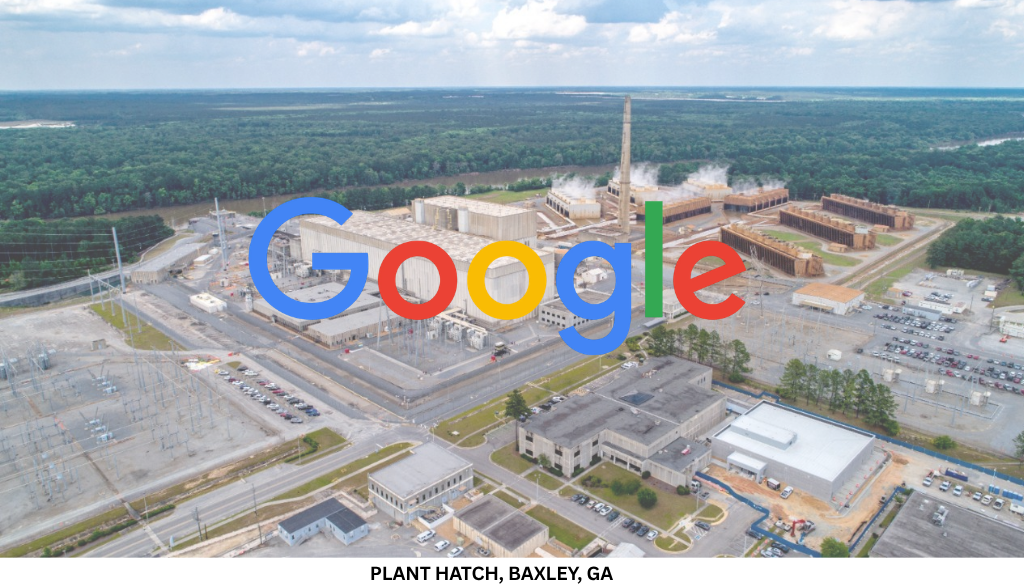
Proposed agreement would increase nuclear generating capacity at the nearby plant as Georgia works to meet growing electricity demand
A newly announced agreement between Georgia Power and Google could bring significant upgrades to Plant Hatch near Baxley, putting a major piece of Georgia’s rapidly changing energy picture practically in Jeff Davis County’s backyard.

Georgia Power and Google announced the agreement Monday, Sept. 21. If approved by the Georgia Public Service Commission, Google would support upgrades to Georgia Power’s ownership share of nuclear units at both Plant Hatch and Plant Vogtle that would increase the amount of electricity the existing reactors can produce.
Together, the upgrades are expected to add approximately 96 megawatts of generating capacity to Georgia’s electric grid. Georgia Power also projects Google’s participation will provide approximately $900 million in benefits to customers over the remaining lives of the nuclear units. (Georgia Power)

For Hazlehurst and Jeff Davis County, however, the Plant Hatch portion of the announcement makes this a particularly local story. The proposal does not call for construction of another reactor at Plant Hatch. Instead, Georgia Power is seeking approval for what is known as an Extended Power Uprate, or EPU, for Hatch Units 1 and 2. In simple terms, an uprate allows an existing nuclear unit to produce more electricity through targeted modifications and upgrades to equipment such as turbines, pumps, motors and cooling systems. Georgia Power says the process allows the reactor to operate at a higher licensed thermal power level while continuing to use the existing reactor fuel design and plant infrastructure. (Georgia Power)
Plant Hatch’s two boiling-water reactors currently have a combined generating capacity of approximately 1,848 megawatts. Unit 1 began commercial operation in 1975, followed by Unit 2 in 1979. Georgia Power owns 50.1% of the plant, which is operated by Southern Nuclear. (Georgia Power)
The Georgia PSC previously authorized preliminary planning, licensing and engineering for potential uprates at Hatch as part of Georgia Power’s 2025 Integrated Resource Plan. Monday’s filing now asks regulators to approve the extended power uprate itself. (Georgia Power)
The agreement creates an unusual connection between one of the world’s largest technology companies and two of Georgia’s existing nuclear power plants. Google would subscribe to a proposed new Nuclear Uprate tariff, known as NU-1, and receive Zero-Emission Credits associated with the additional nuclear electricity produced through the upgrades.
According to Georgia Power, the structure is intended to have Google help support the cost of increasing nuclear generation while protecting customers who do not participate in the program from incremental costs associated with the uprate work. (Georgia Power) Georgia Power estimates the arrangement will generate approximately $900 million in projected benefits for its customers over the lives of the nuclear units.
That figure should not be interpreted as a promise that an individual customer’s electric bill will decrease by a particular amount. It is Georgia Power’s projection of the overall customer benefits resulting from the proposed arrangement.
The announcement comes as Georgia is experiencing extraordinary growth in electricity demand, including demand associated with large data centers. Google specifically referenced its data centers in announcing the agreement. “Google data centers are long-term investments in the communities we call home, catalyzing local economic development and accelerating clean energy deployment,” Lucia Tian, Google’s director of Advanced Energy Technologies, said in the announcement.
Georgia Power described the arrangement as an example of how growth from very large electricity users can be structured to benefit the broader electric system and its customers. (Georgia Power)
That makes the announcement especially timely for this area. Hazlehurst Now has been following the growing data center discussion in South Georgia, including the temporary moratorium and ongoing study of the issue in Jeff Davis County, Telfair County’s proposed data center ordinance and the recently filed lawsuit involving the process surrounding a proposed $20 billion OpenAI data center development in Effingham County.
Much of that discussion has focused on water consumption, taxes, noise, environmental impacts and public involvement. The Plant Hatch announcement highlights another major part of the equation: electricity. Large-scale data centers can require enormous amounts of power, and utilities are planning for how to serve rapidly growing electricity demand while maintaining reliability for existing customers.
Georgia Power operates two nuclear facilities in the state — Hatch and Vogtle — through Southern Nuclear. Together, the company’s nuclear plants provide about 29% of the electricity used in Georgia, according to Georgia Power. (Georgia Power)
Rather than constructing new reactors for this particular proposal, the company is looking to produce additional electricity from reactors already operating. The 2025 Integrated Resource Plan previously approved an uprate of Vogtle Units 1 and 2 expected to provide an additional 54 megawatts. The PSC at that time allowed Georgia Power to proceed with preliminary work to evaluate similar upgrades at Hatch. (Georgia Power) The new Google agreement moves the Hatch proposal another step forward.
The Hatch upgrades are not yet a done deal. Georgia Power filed the agreement with the Georgia Public Service Commission on Sept. 21 in Dockets 44280 and 56002. The filings include the proposed NU-1 tariff and the request for approval of the extended power uprate at Hatch Units 1 and 2. (Georgia Power) The PSC must approve the proposal before the Hatch uprate can proceed as proposed.
Plant Hatch has been part of the landscape of this region for more than half a century. Now, as Georgia faces growing electricity needs and a rapidly expanding technology sector, the plant could play an even larger role in powering the state’s future.
For Jeff Davis County residents, the announcement also provides another piece of a much larger data center conversation. Data centers are not simply questions of where large buildings will be constructed. Their development can affect decisions about power generation, transmission infrastructure, water resources and long-term utility planning far beyond the property where a facility is eventually built.
And in this case, part of Georgia’s answer to increasing electricity demand could involve producing more power from a nuclear plant just down the road from Hazlehurst.
