










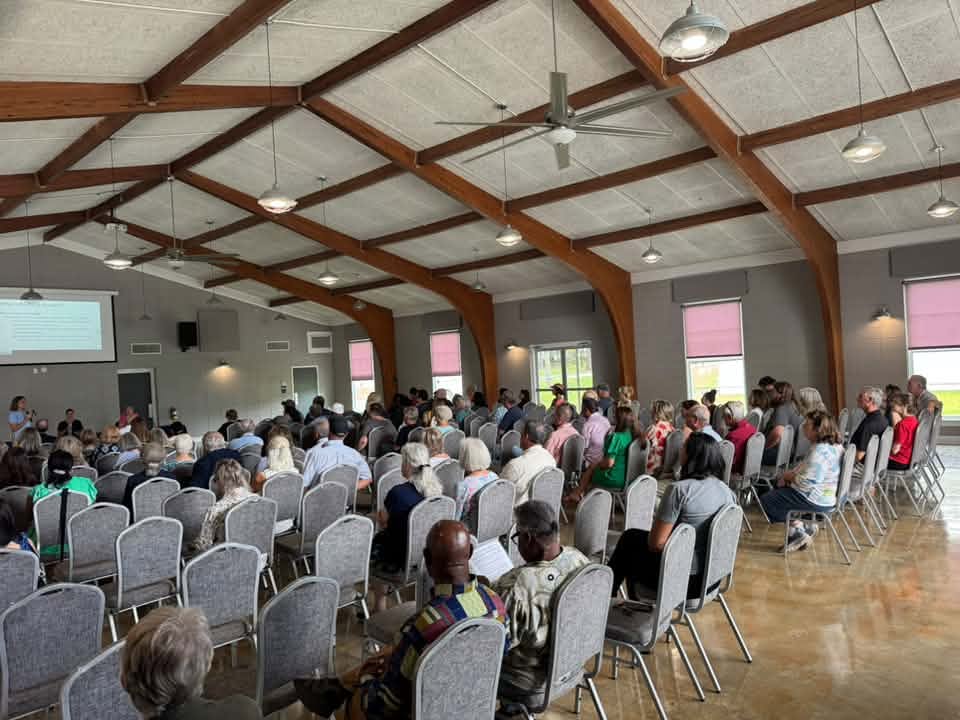
JESUP, Ga. — As communities across Georgia face growing interest from large-scale data center developers, a meeting held Sunday in Jesup focused on questions surrounding water, power, infrastructure and the potential impact of the rapidly expanding industry.


Hazlehurst Now, along with more than 100 citizens from in and around Jesup, attended the meeting, which included presentations from Maggie Van Cantfort, Coastkeeper with Altamaha Riverkeeper, and Shannon Gregory, Riverkeeper and Executive Director of Satilla Riverkeeper.
The speakers discussed issues communities may want to consider when evaluating data center proposals and developing local ordinances, while encouraging residents to research the subject, participate in public meetings and ask questions of both developers and elected officials. The discussion is particularly timely as communities throughout Georgia — including areas of Southeast Georgia — consider how to regulate large data center developments.


Van Cantfort’s presentation focused heavily on water resources and the potential cumulative effects of large industrial water demands. She explained that much of Southeast Georgia relies on groundwater from the Floridan aquifer, a resource shared across a much larger region. Because withdrawals from an aquifer can affect pressure and water availability, she said new requests for significant amounts of water must be considered alongside existing users.
Van Cantfort also discussed the Altamaha River basin and the importance of looking beyond the water demand of a single proposed project. According to Van Cantfort, numerous data centers are proposed throughout the larger basin. She argued that the cumulative water demand from multiple projects could become more significant than the demand from any single facility.
She also cautioned against comparing a proposed data center’s water needs directly with those of an established large industrial user. Using an analogy, Van Cantfort explained that an existing industry already using a large portion of an available resource does not mean the same amount remains available for the next industry. “If you give somebody three quarters of your pie, you don’t have another three quarters to give,” she told those attending.
How a data center is cooled was another major part of the discussion. Computer equipment produces considerable heat, requiring data centers to use cooling systems. Van Cantfort discussed the difference between systems that consume water through evaporation and technologies designed to substantially reduce water consumption.
Rather than requiring one particular cooling technology by name, she recommended that ordinances establish standards requiring the best available technology for minimizing water use and specifically address evaporative cooling.
The speakers also discussed the possibility of using reclaimed wastewater for industrial cooling rather than groundwater. Van Cantfort said that option could reduce demand on the aquifer, but she encouraged communities to look at the entire water cycle. If treated wastewater currently being returned to a river is instead consumed through cooling, she said officials should consider how much water would ultimately be returned to the watershed.
Questions were also raised about chemicals or other substances that could be present in water discharged from cooling systems and whether local wastewater systems would know what to test for. During the question-and-answer portion, residents asked who ultimately determines how much water a data center could use. Van Cantfort explained that a facility receiving municipal water would be subject to the capacity and permitted withdrawals of that municipal system.
Larger groundwater withdrawals are regulated through the Georgia Environmental Protection Division, which evaluates withdrawal permit requests. The discussion also touched on whether large industrial customers should pay higher rates or contribute toward infrastructure improvements necessary to provide the water they require. Those decisions, the speakers said, are among the issues communities can address when negotiating agreements or establishing development requirements.
Another important distinction raised during the meeting involved the type and scale of data centers. Speakers explained that data centers themselves are not new. Smaller facilities supporting banking, cloud storage and other digital services have operated for decades.
The current debate, they said, is increasingly centered on much larger hyperscale facilities, including those supporting artificial intelligence. Van Cantfort cautioned against assuming that a visit to an older, smaller data center necessarily demonstrates what residents could expect from a much larger proposed development.
The amount of electricity required, cooling equipment, acreage and supporting infrastructure can differ significantly depending upon the facility. Large hyperscale facilities can require hundreds of megawatts of power, according to information presented during the meeting. Speakers encouraged communities to examine not only the data center property itself but also the infrastructure required to serve it — including substations, transmission lines and backup or on-site generation. Among the recommendations discussed were requiring developers to provide detailed plans showing how power would reach the site and documentation indicating that the utility can provide the electricity being requested.
Noise was another concern presented Sunday. Cooling equipment, generators and other infrastructure can operate for extended periods, and the speakers cited experiences reported by residents living near data centers in other communities. Video clips shown during the meeting included individuals describing noise and lighting they associated with nearby facilities. Those accounts represented the experiences of those residents and were presented to illustrate issues communities may want to consider when establishing regulations. Recommendations discussed included larger setbacks and buffers between facilities and residential property, measurable noise limits and requirements specifying where noise testing should occur.
The meeting also addressed a question that can receive less attention during economic development discussions: What happens if a project fails, is abandoned or eventually reaches the end of its useful life?Speakers recommended that communities consider financial protections such as surety or decommissioning bonds. Such requirements could provide funding to address a property if a company abandons an unfinished development or eventually closes a facility.
Community benefit agreements were also discussed as a way for local governments to establish commitments from developers related to infrastructure or other community needs. The speakers encouraged communities to put important commitments into enforceable agreements rather than relying solely on promises made during the development process.
Gregory’s presentation focused largely on what residents can do when a data center proposal reaches their community. She emphasized networking, researching proposals, talking with residents of communities that already have data centers and attending government meetings.
Gregory said residents should learn how their local government handles public comment, because procedures can differ from one jurisdiction to another. She also encouraged residents to communicate directly with elected officials and ask questions throughout the process.
There is no single meeting or ordinance that settles every issue associated with data centers, Gregory said, emphasizing that community participation requires persistence. “We’re learning about these things in real time,” Gregory told those attending, referring to the rapid expansion of AI-related data centers. She encouraged residents to continue studying new information as it becomes available.
Transparency was one of the themes running through both presentations. The speakers encouraged local governments to consider requirements for reporting projected and actual water use, power demand and other information associated with a development. They also advocated establishing measurable standards within local ordinances so expectations are known before construction begins.
Because technology continues to change, the discussion included the idea of writing regulations around measurable impacts — such as water consumption and noise — rather than relying entirely on the name of a particular technology.
Although the presentations focused heavily on potential risks associated with large data centers, those attending were also encouraged to research the issue independently and reach their own conclusions. During the closing portion of the meeting, organizers acknowledged that residents do not have to agree about whether a data center would be beneficial to their community.
Instead, those attending were encouraged to study information from multiple sources, ask questions and remain involved as local governments consider future development. Sunday’s Jesup meeting highlighted a discussion that is likely to continue across Georgia as communities encounter proposals for increasingly large data center projects.
For local governments and residents, the questions extend beyond whether a data center should locate in a community. They also include how much water and power it will require, what additional infrastructure will be needed, how neighboring properties will be protected and what safeguards should be in place before a project is approved.
Sunday’s meeting provided residents an opportunity to learn more about those questions before decisions are made. As data center development continues to expand across Georgia, the speakers emphasized that understanding the potential benefits, demands and long-term impacts of these projects will be an important part of the conversation for communities considering them.


