










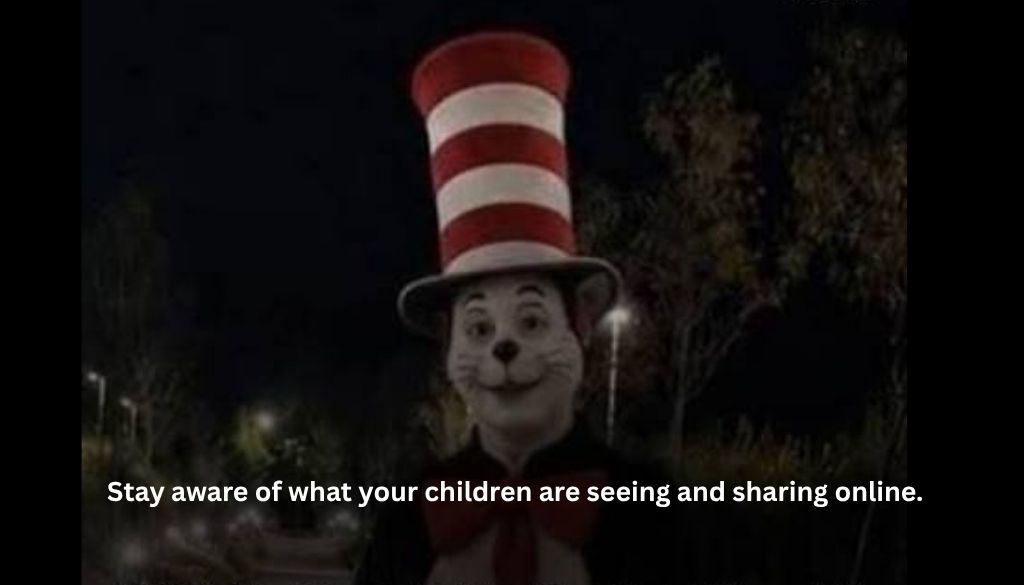
Parents, this may be a good time to sit down with your child and take a look at what’s showing up on their phone. A social media trend involving a frightening version of the familiar “Cat in the Hat” character has taken a more serious turn, with law enforcement agencies and school systems across several states investigating posts that have named schools and, in some cases, individual students.


This disturbing social-media trend involving a sinister version of the familiar “Cat in the Hat” character has now reached the attention of Jeff Davis County Schools, as school districts and law enforcement agencies across the country respond to posts that have increasingly included references to specific schools, communities and students.
Jeff Davis County Schools has alerted families to the trend, which officials say appears to have originated outside the area but has been modified to include local references. Law enforcement presence has also been increased as a precaution. The trend provides an important reminder for parents: what begins as an online joke, meme or viral challenge can quickly have real-world consequences.


What is the “Cat in the Hat” trend? The trend began circulating through platforms including TikTok, Instagram and Snapchat and has included edited and AI-generated images and videos portraying the familiar children’s character in frightening situations. Some posts have depicted the character supposedly appearing in communities, outside homes or in other locations. Many of the images and videos circulating online are fabricated or AI-generated.
But authorities say some versions have gone considerably further. Police in Kentucky reported accounts posting lists naming schools and individual students accompanied by intimidating language suggesting the character was “coming for” them. Kentucky State Police are investigating threats involving several school districts, while schools elsewhere have increased security or restricted access to campuses as authorities investigated similar posts.
A prank can become a police investigation. One case illustrates why parents should pay attention. In Allen County, Kentucky, investigators began looking into threatening messages reportedly received by students through Snapchat and other social media platforms. The person sending some of the messages identified themselves as “Cat in the Hat,” and some messages included AI-generated images.
Investigators eventually identified a juvenile connected with the account. Authorities said the juvenile’s parents cooperated with the investigation and later confirmed that charges would be filed.
Other law enforcement agencies are issuing similar warnings: attaching a viral character or meme to a threatening message doesn’t make the threat harmless. Laredo Police warned that social media posts or messages containing threats or causing fear in schools will be investigated and could result in criminal charges — even when someone intended the post as a prank.
Parents: Don’t Just Ask — Look! That’s perhaps the most important takeaway for local families. Children and teenagers can encounter an online trend long before most adults have ever heard of it. Parents don’t necessarily need to become experts on every new TikTok or Snapchat trend. But they do need to know what their children are seeing, sharing and posting.
Sit down together and look. Ask your child whether they’ve seen the Cat in the Hat posts. Ask whether anyone they know has shared one, created one or received a message from an account participating in the trend. And use the conversation to remind them of something even bigger: something being viral doesn’t make it safe, true or harmless.
Law enforcement guidance surrounding the trend offers several practical lessons for families:
- Don’t provide personal information such as your school schedule, bus stop, address or current location.
- Don’t respond to or challenge threatening accounts.
- If a post names your child, another student or a school, take screenshots and immediately tell a parent, school administrator, school resource officer or law enforcement.
- Don’t keep resharing a threatening post. Sharing it repeatedly can spread fear and complicate an investigation.
- Understand that making a threatening post “as a joke” can still result in a law-enforcement investigation and possible consequences.
Another lesson we should take to heart: Ai isn’t always reality. This trend also highlights a challenge today’s children will increasingly face. A photo or video appearing on a phone screen is no longer proof that something actually happened.
Artificial intelligence can create remarkably convincing images and video of events that never occurred. Some of the frightening content associated with this trend has been AI-generated, making it difficult for younger viewers in particular to separate fact from fiction. Teaching children to stop and question what they’re seeing — Who posted this? Is there a reliable source? Could this have been generated or altered? — is becoming an important part of online safety.
This article isn’t intended to create fear. It’s intended to give parents information before something appears on a child’s phone. Tonight might be a good opportunity to put the phones on the table, scroll together and have a conversation. Because sometimes the best way to find out what’s happening in your child’s online world is simply to take a look.


