



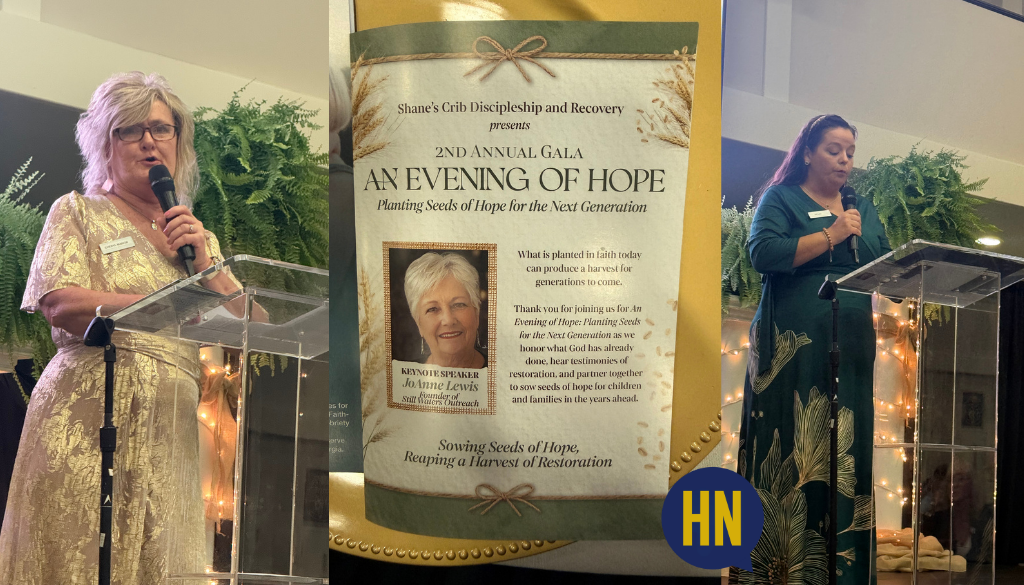
The Hazlehurst Now team was honored to attend the Second Annual Shane’s Crib Discipleship and Recovery Gala, “An Evening of Hope: Planting Seeds of Hope for the Next Generation,” an evening centered on recovery, restoration, faith and a vision to help mothers rebuild their lives alongside their children.

Held in Douglas, the gala brought together supporters, graduates, residents, ministry leaders, churches, businesses and volunteers to celebrate the work of Shane’s Crib and support its next major project — Grace Harbor Transitional Sober Living & Children’s Home.
The ministry has set a 2026 campaign goal of $239,000 to transform an existing commercial building on its Douglas campus into a residential home where women who have progressed through recovery can live with their children.

The evening opened with Christina Northern, director of Shane’s Crib Douglas and herself a graduate of the program. Northern told guests that when she entered the program in 2018, others invested in her life and taught her what love and restoration could look like. “Someone took a chance and planted a seed for me,” Northern said, explaining that the evening was not only about current residents, but about the next generation. That theme — one life restored becoming the beginning of restoration for an entire family — continued throughout the night.
Guests heard emotional testimonies from other women who described years of addiction, trauma, broken relationships and separation from their children before finding recovery through Shane’s Crib. Graduate Beverly Harris shared how addiction affected generations of her family and ultimately damaged her relationship with her daughters. Through the program, Harris said she learned forgiveness, developed a stronger faith and began rebuilding those relationships. She is now in aftercare, serves as a senior house leader, manages the Hidden Treasures thrift store and is continuing training to help others in recovery. Her story also came full circle when her youngest daughter later entered the same program. “This is a family disease,” Harris told those gathered, explaining that recovery can also become a family story.
Another graduate, Megan Bullard, spoke about homelessness, incarceration, addiction and losing contact with her children. She described Shane’s Crib as providing far more than housing and food. It gave her discipline, self-awareness, healing, safety and, perhaps most importantly, hope. Bullard told the audience that she has since rebuilt major parts of her life, including employment, transportation and financial independence, while continuing in ministry and recovery. And after years without contact with her children, she recently experienced something she once believed might never happen again — spending time with them. Her story became one of the evening’s clearest examples of the gala’s theme: restoration can reach beyond the individual and into the next generation.
Keynote speaker JoAnne Lewis, founder of Still Waters Outreach, reflected on the early years of the Douglas recovery ministry and the community effort that helped make it possible. Lewis described herself as part of the “birthing process” that eventually led to what is now Shane’s Crib Douglas. She said the work was never accomplished by one person. “It takes a community,” Lewis told guests, emphasizing the role of volunteers, prayer partners, donors and community supporters. Lewis also recalled how quickly the original property was acquired, renovated, furnished and opened to residents — something she said would not have been possible without strong partnerships and faith. Her message to the crowd was also a call to continue that involvement. “The battle’s not over,” she said. “There’s still work to be done.”
Shane’s Crib Executive Director Cheryl Mainor said that next step is Grace Harbor. While women may find recovery and stability through the program, Mainor said one piece is still painfully missing for many mothers — their children.
A video shown during the gala illustrated that reality through one simple image: a playground on the Douglas campus. For a few hours during visits, the playground comes alive with children. Then the visits end.Cars pull away, mothers wave goodbye, and the swings become still again.
Grace Harbor is intended to change that. The planned transitional home would allow mothers who have done the work required in recovery to move into a setting where their children can live with them while they continue rebuilding their lives.
Plans call for 10 bedrooms as well as a therapeutic playroom for children. The existing building will require extensive renovations, including electrical work, plumbing, flooring, fire protection systems, county connections and other code-related improvements. The projected cost: $239,000.
Mainor told attendees contractors are already prepared to begin once funding allows the work to move forward. The goal, she said, is simple but profound — to create a place where a recovering mother can finally put her child to bed at night without having to say goodbye again.
The evening ended on a deeply personal note with the Lighting of the Candles ceremony. Mainor was joined by her husband Dennis, daughter Brandi and granddaughter Kirsten as the family remembered Mainor’s son, Shane, for whom the ministry is named. Shane died in 2007. “In life, he gave. In death, he brings hope,” Mainor said.
Residents were then invited forward as candles were lit in memory of Shane and others whose lives have been affected or lost through addiction. The ceremony served as both remembrance and reminder — behind every recovery story is a family, and behind every loss is another reason to continue the work.
The gala also included dinner, fellowship, an interpretive dance by the Frontline Warriors, a silent auction, door prizes and the ministry’s annual cake auction. Dozens of churches, businesses, organizations and individuals helped sponsor tables, donate items and support the evening.
But the message remained consistent from beginning to end. Shane’s Crib describes its mission as rescuing men and women, redeeming lives and restoring families. Through its residential campuses, aftercare programs, thrift stores and additional ministries, the organization continues working with men and women recovering from addiction throughout Southeast Georgia.
Now, with Grace Harbor, that mission is expanding once again. This time, the focus is not only helping a mother heal. It is creating a place where, when she is ready, her children can come home too.
