









As discussion surrounding potential data center development continues in Jeff Davis County, a published resource from the University of Georgia Cooperative Extension provides information about one of the most frequently raised questions surrounding these facilities: water use and its potential impact on local water resources. The UGA Extension publication, Understanding How Data Centers Impact Surface and Ground Waters, examines how data centers use water, differences among cooling systems, potential effects on groundwater and surface water, and questions communities may want to consider as data center development expands.


Why do data centers need water? Data centers house large numbers of computer servers that operate continuously and generate significant heat. Water is not used as a raw material in their operations; instead, it is primarily used to cool equipment and prevent overheating. How much water a facility requires can vary significantly depending on its size, cooling technology, location and equipment.
UGA Extension explains that many large modern data centers use evaporative cooling, which can be energy efficient but consumes water through evaporation. Closed-loop systems continually reuse water and can reduce water consumption by as much as 70% compared with traditional open evaporative systems, while newer direct-liquid cooling technologies can also significantly reduce water use.
That creates an important tradeoff: systems that conserve more water may require more electricity, while systems designed to reduce electricity consumption may use more water. Basically, the more water it uses, the less electricity it needs, but the less water it needs, means more electricity is consumed.
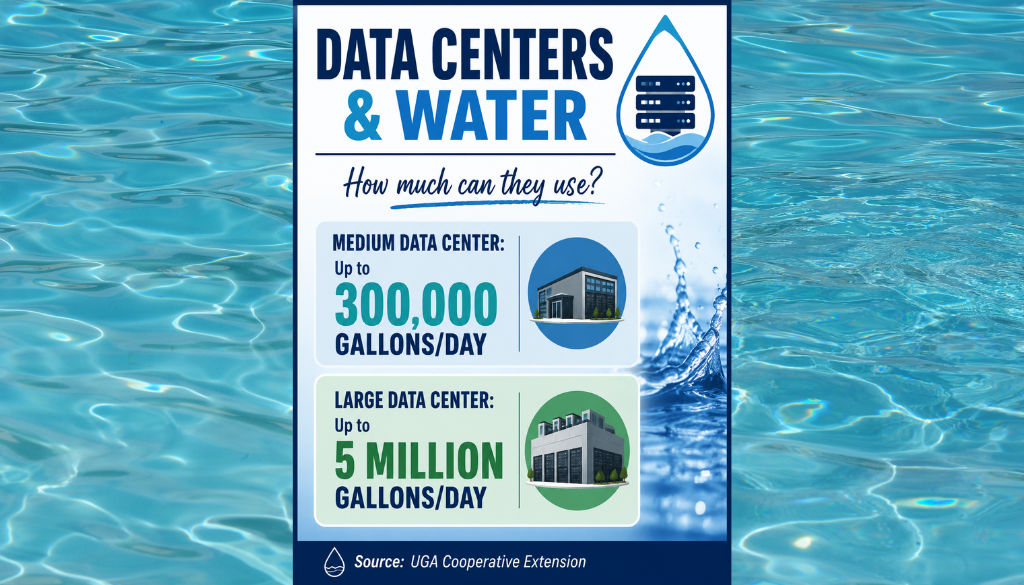
Water consumption can vary dramatically. According to information compiled in the UGA report, a medium-sized data center can consume up to 300,000 gallons of water per day, while some large facilities can use as much as 5 million gallons per day. However, UGA stresses that those numbers should not be assumed for every data center. Water demand varies considerably from one facility to another depending on the cooling system and other factors.
Nationally, data centers account for a relatively small portion of overall U.S. water consumption. The concern, according to the report, is that data centers tend to be concentrated in particular areas, meaning local impacts can be significant even when their share of nationwide water consumption is small.
Potential Concerns for Communities
UGA Extension identifies several water-related issues communities may consider when evaluating data centers.
Heavy groundwater withdrawals can potentially lower aquifer levels, particularly in drought-prone or heavily developed areas. Large surface-water withdrawals can also affect streamflow and increase competition among residential, agricultural and municipal users.
Water discharged from cooling systems may contain minerals and chemicals used to control corrosion, scaling and biological growth and, depending on the system, may require treatment or environmental permits.
Among the concerns commonly raised by communities are drinking-water availability, private wells, water quality, utility costs, drought resilience, long-term cumulative impacts and transparency regarding water consumption.
UGA Encourages Information and Collaboration
UGA encourages information and collaboration. The report also makes an important point: data centers have become an indispensable part of the growing digital economy, supporting everything from banking and healthcare to streaming, cloud computing, social media and artificial intelligence.
Rather than presenting data centers as simply good or bad, UGA Extension emphasizes the importance of communities understanding the technology involved and working with industry as best practices continue to evolve.
For communities where data centers are proposed, UGA suggests considering baseline water-quality testing so future results can be compared with conditions that existed before development. The report also stresses the importance of collaboration between communities and the data center industry.
As Jeff Davis County considers what data center development could mean locally, the UGA Extension report provides residents and local leaders with research-based information that can help inform that conversation.
The full report (source of this article) can be found here: Understanding How Data Centers Impact Surface and Ground Waters, University of Georgia Cooperative Extension, TP 121.


