



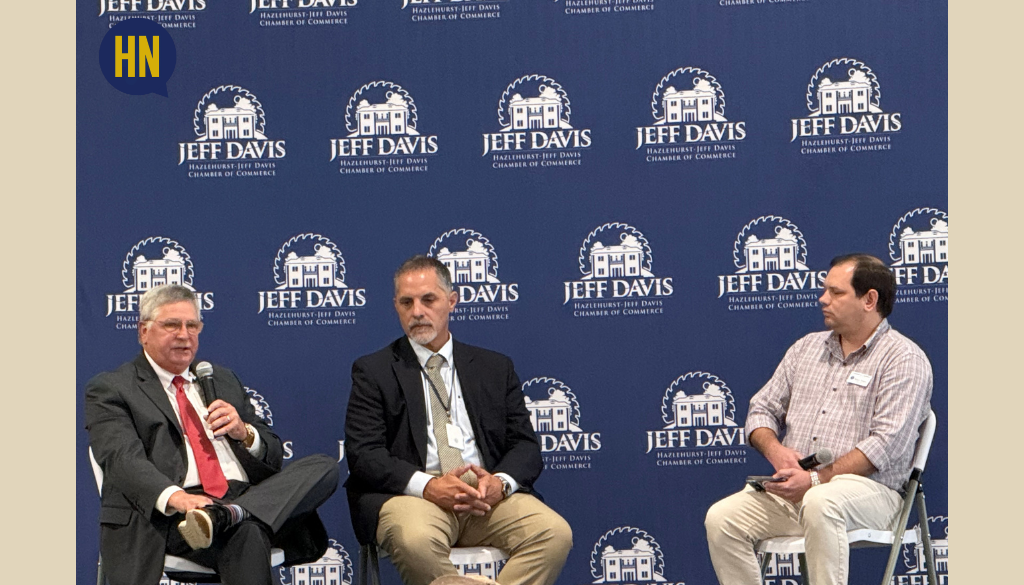
Education and healthcare took center stage Monday as community leaders gathered for the State of the Community Panel Discussion, presented by the Hazlehurst-Jeff Davis County Chamber of Commerce. The first session of this year’s series featured Dr. Chris Roppe, Superintendent of Jeff Davis County Schools, and Barry Bloom, CEO of Jeff Davis Hospital, who provided updates on two of the community’s largest and most important institutions.

Chamber President and CEO Oakley G. Perry welcomed those attending and noted the growth of the event since its launch last year. The Jeff Davis County Development Authority served as presenting sponsor of the series, with Chairman Bo Reese offering opening remarks. Reese spoke about his appreciation for Jeff Davis County and recognized the work taking place throughout local organizations.
The presentations that followed covered everything from school funding and student achievement to hospital services, quality of care, financial stability and the challenges facing rural healthcare.

Roppe began by putting the size of the school system into perspective: approximately 2,900 students and 500 employees, with a budget that has grown from nearly $37 million last year to just over $37 million this year. One of the biggest factors driving that increase, he said, is employee health insurance.
Roppe told those attending that the district now pays more than $1,900 per month for health insurance for individual employees, with particularly dramatic increases over the years for classified employees such as paraprofessionals, office staff, bus drivers, maintenance workers and custodians. Those costs are largely outside the district’s control, he explained. State-mandated salary increases can also increase local expenses because funding does not necessarily cover every position affected.
Despite those pressures, Roppe said the district remains focused on fiscal responsibility. He explained that approximately 58.8% of the district’s funding came from the state, 30.5% from local sources and 10.7% from federal sources, according to the district’s 2025 audit.
Dr. Roppe also addressed an issue receiving considerable attention locally: the school system’s millage rate. For many years, the district maintained a rate of 12.75 mills before state equalization requirements led to increases beginning in 2016. The rate eventually reached 14 mills, which was then required for the district to receive equalization funding intended to help less property-wealthy school systems.
After state law changed to allow districts to go below 14 mills without losing that funding, the Jeff Davis County Board of Education reduced its rate to 13.5 mills last year. Roppe said Monday that this year’s calculated rollback rate is 12.816 mills and that he anticipated the board would adopt the rollback rate or possibly go even lower when it met later in the day. (During the Board of Education Meeting held later in the day, the board actually approved a new millage rate of 12.5 mills.)
The rollback rate is intended to offset increases in the tax digest so that, generally speaking, the taxing authority does not collect additional property-tax revenue solely because existing property values increased.
Roppe also highlighted academic progress across the district. Jeff Davis Primary School students do not take Georgia Milestones assessments because the school serves Pre-K through second grade, but Roppe said student growth placed Jeff Davis second among school systems in its RESA district.
Beginning in third grade, when state Milestones testing begins, he said Jeff Davis students ranked first in the RESA in some areas while performing above regional and state averages in others. Roppe said the district’s goal is to ensure that being educated in a rural community does not limit the opportunities available to students.
He also discussed the district’s approach to addressing challenges that sometimes must be resolved before academic progress can occur. One example came from Pre-K, where educators adjusted a 45-day action plan to concentrate first on student behavior and basic school routines. Roppe said the change ultimately contributed to some of the strongest academic gains the program had experienced in recent years.
The district is also serving 393 students identified for special education, with 62 teachers providing more than 1,500 services, according to Roppe. The goal, he said, is to provide those supports for as long as students need them while helping students become increasingly independent.
During the panel discussion, Roppe was asked how the school system is responding to the needs of local employers and preparing students for careers and postsecondary education. He pointed to the district’s participation in the Southern Pines College and Career Academy, which allows multiple school systems to combine resources and offer opportunities that may be difficult for one rural district to provide alone.
He also emphasized “soft skills” — including communication, making eye contact, shaking hands and interacting appropriately in a workplace. Roppe said those skills are increasingly being incorporated into activities beginning at the middle-school level.
School safety was another topic during the panel. Roppe said the district continually evaluates its safety plans and drills. Measures already in place include OpenGate weapons-detection systems throughout the district and at events such as football games, along with staff badges that can be used during emergency lockdown situations.
Mr. Bloom’s presentation began with an explanation of what it means for Jeff Davis Hospital to operate as a Critical Access Hospital. The federal designation limits the hospital to 25 beds and generally limits inpatient stays to 96 hours, while providing a different reimbursement structure designed to help sustain rural hospitals.
Bloom recalled a much different financial picture for Jeff Davis Hospital approximately a decade ago, when its future was uncertain. Today, he said, the hospital is financially sound and growing. He also emphasized what losing a local hospital would mean for residents who would otherwise have to travel for emergency and inpatient care.
Bloom cited an economic-impact estimate of approximately $83.9 million annually, describing that figure as the broader economic effect of hospital employment and spending circulating throughout the community rather than direct hospital spending alone. Jeff Davis Hospital employs approximately 300 people.
Bloom outlined several services now available locally. Jeff Davis Hospital sees more than 10,000 emergency-room visits annually and operates a hospitalist program that provides physician coverage for hospitalized patients around the clock. The hospital has also established its own transport service to help move patients to a higher level of care when necessary.
Newer or expanded services discussed Monday included nuclear medicine, pulmonary rehabilitation, infusion therapy, behavioral-health services through Starting Point and pain management. Bloom said the pain-management program provides another option for patients dealing with chronic pain, with an emphasis on reducing reliance on opioids and other narcotics when appropriate.
He also discussed the hospital’s outpatient clinics and noted the return of a Jeff Davis native to practice medicine locally after completing her medical training.
Quality of care was one of Bloom’s major themes. A Q2 2026 Quality Scorecard distributed at the meeting shows Jeff Davis Hospital reporting 100% compliance in several measures, including its stroke protocol, procedure time-out compliance and DVT prophylaxis.
The hospital reported that 92% of patients said doctors always communicated well, compared with a 79% state average and 80% national average shown on the scorecard. Additionally, 94% of patients gave the hospital a rating of 9 or 10 out of 10, compared with 71% statewide and 72% nationally. The scorecard also reports zero hospital-acquired C. difficile infections and a 0% medication error rate for the period.
Jeff Davis Hospital was named the 2025 Small Hospital of the Year by Alliant Health and reports receiving five-star patient satisfaction recognition from the National Rural Health Association for five consecutive quarters.
Asked during the panel why the hospital has performed well, Bloom credited its employees and a culture centered on putting patients first.
Despite the hospital’s improved financial position, Bloom said rural healthcare continues to face significant challenges. Reimbursement is one. Bloom said Jeff Davis Hospital bills approximately $100 million annually but ultimately receives roughly $33 million after contractual adjustments and reimbursement rates from Medicare, Medicaid and private insurers.
Recruitment is another challenge. Rural hospitals often compete with larger communities that can offer healthcare professionals more amenities and opportunities. Bloom said Jeff Davis Hospital is increasingly focused on developing relationships with local students interested in healthcare, assisting them through their education and encouraging them to return home to practice.
Rising construction costs, interest rates and the cost of investing in facilities are additional pressures.
During the panel discussion, Bloom said the hospital is currently doing well financially and credited careful stewardship and oversight from the hospital’s board.
When asked what measurable commitment the community could hold him accountable for when the group meets again next year, Bloom returned to one word: quality. He said quality cannot be treated as something a hospital achieves once and considers finished.
Bloom also highlighted the Georgia HEART Rural Hospital Tax Credit Program. Information distributed at the meeting explains that eligible Georgia taxpayers can contribute through the program and designate Jeff Davis Hospital, receiving a dollar-for-dollar Georgia state income tax credit for the approved contribution.
The process begins with an application through Georgia HEART, followed by approval from the Georgia Department of Revenue, payment and receipt of documentation to claim the credit on the taxpayer’s 2026 Georgia income tax return.
Roppe was also asked what the community should hold the school system accountable for during the coming year. His answer centered on students.
He said Jeff Davis County Schools received a 4.0 rating on the state’s five-point measure of fiscal responsibility, which considers spending per student in relation to academic performance over a three-year period. For the district, Roppe said, fiscal responsibility to taxpayers must remain connected to using those resources to give students the best opportunities possible.
Monday’s discussion offered residents a broad look inside two institutions that touch nearly every family in Jeff Davis County. While both leaders acknowledged significant challenges — from rising costs and workforce recruitment to changing student needs and healthcare reimbursement — both also pointed to measurable progress and a continued focus on the people they serve.
The Chamber’s State of the Community series continues next Monday with a second session featuring the City of Hazlehurst and Jeff Davis County, giving residents another opportunity to hear directly from local leaders about the issues, challenges and priorities shaping the community.
