



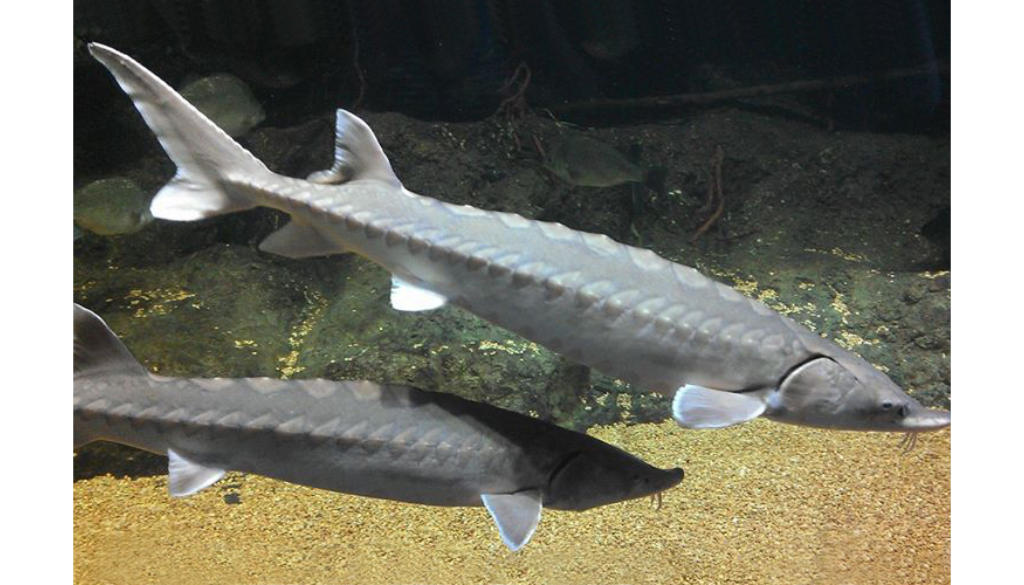
SOUTH GEORGIA — Beneath the dark, tea-colored waters of the Satilla River lives one of Georgia’s most extraordinary and seldom-seen creatures. It has a body covered in armor-like plates, a long pointed snout and a history that stretches back millions of years.

Meet the Atlantic sturgeon, an endangered fish that has been swimming through the waterways of North America for generations — and whose ancient ancestors inhabited Earth during the age of dinosaurs.
While many South Georgians are familiar with the Satilla River’s fishing, boating and natural beauty, fewer may realize that this winding blackwater river provides important habitat for a species with such an extraordinary past.

The Atlantic sturgeon looks unlike most fish commonly found in South Georgia’s rivers. Instead of traditional scales, its body is protected by five rows of hard, bony plates called scutes. Four whisker-like sensory organs, known as barbels, help the fish locate food along the river bottom.
Its mouth is located underneath its head, allowing it to feed on bottom-dwelling organisms such as worms, crustaceans and mollusks.
Atlantic sturgeon can grow to remarkable sizes. According to NOAA Fisheries, the largest individuals may reach approximately 14 feet in length and weigh as much as 800 pounds. However, those figures represent the upper extremes for the species, not the typical size of fish found in Georgia’s rivers.
The sturgeon family belongs to an ancient lineage that dates back roughly 200 million years. Although today’s Atlantic sturgeon is not the same species that existed during the dinosaur era, its ancestors were already swimming in prehistoric waters. That remarkable history has earned sturgeon a reputation as living links to the distant past.
The Atlantic sturgeon is not simply an occasional visitor to South Georgia. Scientists have documented young Atlantic sturgeon in the Satilla River, providing evidence that the river supports reproduction.
Researchers studying the species have captured, measured and tracked sturgeon to better understand their movements, habitat preferences and survival. The Satilla is also among the rivers included in federally designated critical habitat for Atlantic sturgeon.
That designation recognizes the importance of protecting areas that provide essential conditions for the species’ conservation. For a fish whose population has declined dramatically over the past century, rivers capable of supporting reproduction are especially valuable.
One of the most fascinating characteristics of Atlantic sturgeon is their migration. Unlike fish that spend their entire lives in freshwater, Atlantic sturgeon are anadromous. That means they spend much of their adult lives in coastal and ocean waters but return to freshwater rivers to reproduce.
The Satilla River provides part of that freshwater environment. Young sturgeon remain in freshwater and estuarine habitats as they develop before eventually moving into coastal waters.
Years later, mature fish may return to rivers to spawn, continuing a life cycle that depends on healthy connections between inland waterways and the Atlantic Ocean.
Sturgeon are also slow to mature compared with many other fish species. Females may take more than a decade to reach reproductive age and do not necessarily spawn every year. That makes the loss of mature fish particularly difficult for populations to overcome.
Despite belonging to a lineage that has endured for millions of years, Atlantic sturgeon face serious threats today. Historically, commercial fishing dramatically reduced their populations. Sturgeon were harvested for their meat and eggs, which were processed into caviar.
Although commercial harvesting of Atlantic sturgeon is now prohibited in the United States, other threats remain. These include accidental capture in fishing gear, collisions with boats and ships, water-quality problems and the loss or alteration of important habitat.
The South Atlantic population of Atlantic sturgeon is federally listed as endangered under the Endangered Species Act. Federal protections and ongoing research are intended to help the species recover, but its slow growth and reproductive cycle make recovery a long-term effort.
The Satilla River winds through a landscape of forests, wetlands and rural communities before eventually reaching the Georgia coast. Its dark waters support a remarkable variety of wildlife, much of which remains unseen by people enjoying the river from its banks or in boats.
The Atlantic sturgeon is one of those hidden treasures.
Most residents will probably never encounter one. Yet the knowledge that these ancient-looking fish continue to use the Satilla River adds another layer to the area’s natural history.
In a world where so much has changed, a fish with roots reaching back to prehistoric times still depends on the health of a South Georgia river.
And that is a remarkable story worth telling.
