



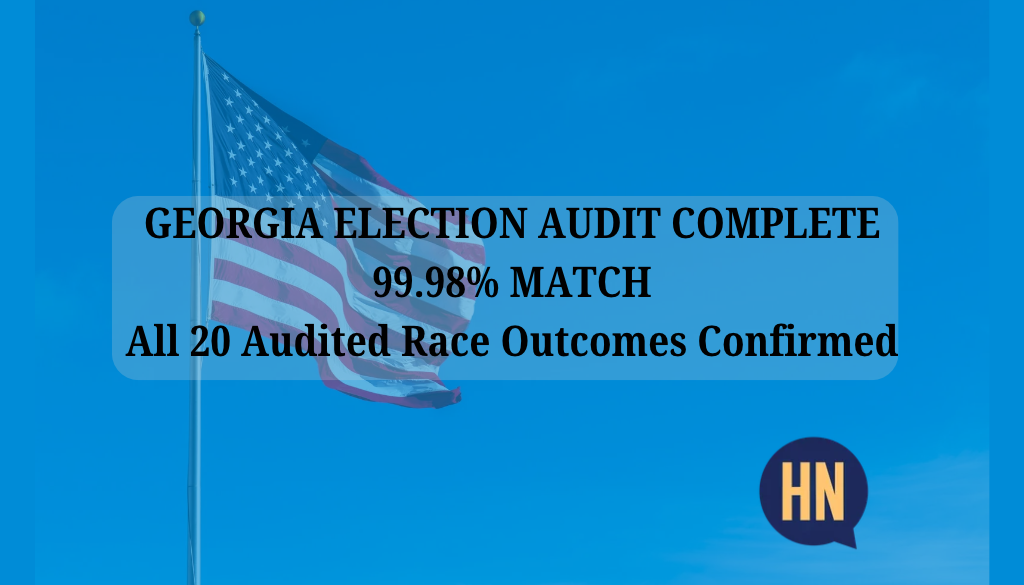
More than one million ballots reviewed, with 99.98% agreement between audited votes and original election results.

ATLANTA, Ga. — Georgia election officials have completed a historic series of audits following the November 3, 2026, general election, confirming the reported outcomes in all 20 contests examined.
As previously reported by Hazlehurst Now, Secretary of State Brad Raffensperger announced last week that Georgia would conduct a record number of post-election audits to verify the accuracy of election results.

The findings, released Thursday, November 19, represent what state officials describe as the largest number of statewide and federal risk-limiting audits conducted following an election in U.S. history.
Election Audit by the Numbers
- 20 election contests audited
- 600 randomly selected batches of ballots reviewed
- 1,050,204 ballots examined
- 1,539,171 individual vote opportunities reviewed
- 99.98% agreement with original reported results
- 0.02% discrepancies
- No election outcomes changed
According to election officials, the small percentage of discrepancies fell within the expected range of human error associated with hand counting.
The audits covered six statewide contests and all 14 of Georgia’s congressional races.
The statewide contests included:
- U.S. Senate
- Governor
- Lieutenant Governor
- Secretary of State
- Attorney General
- Commissioner of Agriculture
The audits confirmed the reported victories in each of these races, including Jon Ossoff’s reelection to the U.S. Senate and Keisha Lance Bottoms’ election as Georgia’s next governor.
The process began November 12 with the public rolling of dice to generate a random number used to select batches of ballots for review.
County election workers then manually counted votes from selected paper ballots and compared their findings with the original machine-tabulated totals.
Georgia used what is known as a risk-limiting audit, a statistical process designed to determine whether sufficient evidence exists to confirm the reported winner of an election.
The state established a 5% risk limit. This means that if a reported election outcome were incorrect, the audit process would have at least a 95% chance of escalating the review sufficiently to correct that outcome.
VotingWorks, a nonpartisan nonprofit election technology organization, assisted Georgia officials with the audit process and the preparation of the findings.
Raffensperger credited county election officials for their work throughout the election and auditing process. “Georgia continues to be the gold standard for election security and transparency,” Raffensperger said in Thursday’s announcement.
The Secretary of State’s Office has also made supporting audit data, ballot inventories and machine-generated vote totals available to the public.
The findings provide statistical evidence supporting the reported winners in all 20 contests examined. A risk-limiting audit is not the same as a statewide recount of every ballot. It uses randomly selected ballots and statistical analysis to verify election outcomes.
The audit’s 99.98% agreement rate applies specifically to the individual vote opportunities examined during the review.
Local races, including municipal and county contests in Jeff Davis County, were not among the 20 contests included in this announced audit.
Georgia residents can review the official findings and supporting documentation through the Secretary of State’s website.
Official Secretary of State Announcement:
https://sos.ga.gov/news/historic-number-risk-limiting-audits-confirm-election-outcomes
Georgia Election Audit Information:
https://sos.ga.gov/page/elections-audit-information
Hazlehurst Now will continue to monitor any additional election-related reports or findings released by state officials.
Sources: Georgia Secretary of State’s Office, Atlanta News First, WRDW/WAGT and WSB-TV.
