



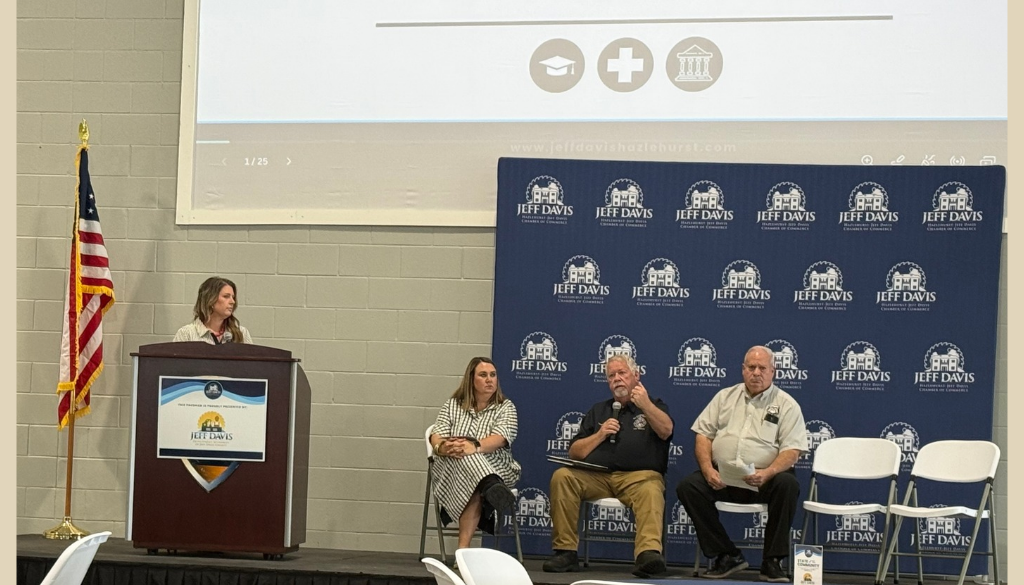
Hazlehurst and Jeff Davis County officials provide updates on government operations, public safety, water, roads and issues facing the community
From property taxes and Hurricane Helene recovery to water loss, roads, emergency services and the growing discussion surrounding data centers, Hazlehurst and Jeff Davis County leaders covered a wide range of issues during the second session of the Hazlehurst-Jeff Davis County Chamber of Commerce’s State of the Community Panel Discussion.

Hazlehurst Now attended the session, which featured Jeff Davis County Administrator Jayme Crosby and Hazlehurst Mayor John Ramay, along with department heads who provided updates on the day-to-day operations and longer-term challenges facing local government. The program followed the first State of the Community session, which featured Jeff Davis County Schools Superintendent Dr. Chris Roppe and Jeff Davis Hospital CEO Barry Bloom.
County Budget Increases; Millage Rate Drops
Crosby began the county presentation with an overview of finances. She said the county’s budget increased from approximately $15.3 million for Fiscal Year 2026 to about $15.9 million for FY2027, an increase she characterized as relatively modest considering rising costs. Crosby credited county department heads with working within their budgets and attempting to control expenses.

She also discussed the county’s recently approved 11.5-mill property tax rate, down from 12.175 mills the previous year. According to Crosby, county officials initially considered a rate of 11.56 mills before commissioners ultimately approved 11.5 mills.
Crosby also discussed changes affecting homesteaded property under House Bill 581 and said officials were hopeful eligible property owners would see relief reflected on tax bills. Because individual tax bills depend on factors including assessed value and exemptions, Hazlehurst Now is not making projections about what the new millage rate will mean for individual property owners.
Recreation Participation Growing
Recreation Director, Josh Horton reported increased participation in several youth programs.
Soccer participation was reported at approximately 198 children, up 8%, while football and cheer participation increased approximately 23% to 272 participants. The recreation department also introduced girls flag football this year, with 44 girls participating in the first-year program.
Horton said the department would like to expand recreational opportunities for children with special needs and senior citizens, but identified one major challenge: volunteers. Coaches and other volunteers are essential to expanding programs, particularly as participation continues to grow.
EMS Expands Around-the-Clock Coverage
Jeff Davis County EMS also reported a significant expansion in service. EMS Director Andrew Waldron said the county previously operated one 24-hour advanced life support ambulance, with an on-call crew available when needed. The department now operates two 24/7 ALS ambulances, along with a 12-hour daytime ALS unit that can assist with interfacility transports.
Waldron reported 1,699 calls year-to-date, including 102 interfacility transports. He said the department currently has 13 full-time employees and eight part-time employees. The additional transport capability is intended in part to help Jeff Davis Hospital move patients who require specialized treatment elsewhere without reducing the county’s ability to respond to 911 calls.
Roads, Resurfacing and Better Tracking of Requests
Chris Horton of the county road department discussed efforts to improve both infrastructure and communication with residents.
The county’s official website says its road system includes more than 360 miles of dirt roads and approximately 209 miles of paved roads. During the State of the Community presentation, Horton said a new Road Department shop was constructed using federal American Rescue Plan Act funds rather than local property-tax dollars.
The department has also implemented a system for documenting and tracking road-maintenance requests so officials can better follow a complaint from the initial call through completion.
Three road-resurfacing contracts have been awarded with state and Georgia Department of Transportation assistance, with officials saying the projects represent close to $3 million in resurfacing work. A specific construction start date was not announced.
Helene Recovery Continues
Nearly two years after Hurricane Helene, the storm remains a major part of local government operations. Crosby said Jeff Davis County has received approximately $59 million for debris removal, with those funds paid to the contractors that performed the work, including Phillips & Jordan and DebrisTech.
Emergency Management Agency Director, Charles Wasdin cautioned that the figure should not be interpreted as money simply added to county coffers. Much of the federal funding is reimbursement for eligible disaster expenses and payments associated with recovery work. Officials said the debris-removal portion of the recovery is largely closed out, while other FEMA categories remain open. The process could continue for years.
County emergency management is also revising its planning based on lessons learned from Helene. The county’s hazard mitigation plan now specifically addresses hurricanes — something officials said had not previously been included because tropical storms, rather than hurricanes, historically represented the greater local threat. Officials are also pursuing hazard-mitigation funding for generators at critical facilities, including water infrastructure and public-safety locations.
Fire Department Working to Improve Coverage
Charles Wasdin, who is also the Fire Chief, discussed changes intended to improve fire protection in both Hazlehurst and the unincorporated county.
He said the city and county worked together to add four full-time firefighters, bringing the department to 14 full-time personnel in addition to volunteers. The department is also working toward improvements that could affect its ISO fire-protection classifications, including completion of a training facility and development of a stronger rural water-shuttle operation.
Wasdin said some portions of the county remain outside the five-road-mile distance from a fire station used in ISO evaluations. Officials are exploring automatic-aid arrangements with neighboring counties to improve response and coverage in some of those areas.
He also pointed to the escalating cost of fire apparatus as a continuing challenge, saying trucks that once cost less than $200,000 can now cost several times that amount.
Mayor Ramay Emphasizes Working as One Community
Ramay opened the city’s portion of the program by reflecting on the community response to both the Sept. 11 attacks and Hurricane Helene. His central message was that cooperation should not require a tragedy. “We don’t need another tragedy to remind us” of the importance of coming together, Ramay told the audience, emphasizing cooperation among the city, county, schools and community.
Ramay pointed to several city initiatives, including outsourcing garbage and trash collection, resurfacing city streets, addressing problem areas and establishing regular maintenance for drainage systems and ditches.
He also highlighted the city’s work with Jeff Davis County Schools to provide water and sewer service to the new primary school as an example of different local entities working toward a shared community goal.
City Reports Major Reduction in Water Pumped
One of the more closely watched city issues has been water loss. During the Q&A, officials were asked about an earlier report that approximately 61% of water pumped by the city was unaccounted for.
A city water representative reported that from Jan. 1 through Aug. 31, 2025, approximately 351 million gallons were pumped from city wells. During the same period in 2026, approximately 296 million gallons were pumped — about 55 million fewer gallons.
However, officials did not provide an updated percentage for unaccounted-for water.
They said approximately 480 customer accounts still involve meters that need to be resolved because of faulty or inaccurate readings, including some meters recording only minimum usage.
Ramay said the city has implemented an ongoing meter-replacement maintenance program and is also working on regular maintenance of fire hydrants. The city’s official website confirms that its Water and Sewer Department is responsible for the municipal water and sewer systems and related infrastructure.
Data Centers Draw Direct Questions
Data centers — one of the most closely watched local issues this year — were addressed directly during the public Q&A.
Asked what specific conditions a data center would have to meet before Jeff Davis County would consider supporting a development, Crosby said there is not yet a specific answer. She said the county, City of Hazlehurst, City of Denton and Joint Development Authority are working together on forming a committee that would research the issue. The goal, Crosby said, is to examine “the good, the bad, the ugly” and ultimately bring information back to the community through an open forum.
A follow-up question asked whether the data center debate had changed the county’s thinking about land-use planning and development standards. Crosby said it had. She said Jeff Davis County already has a limited land-use ordinance and that commissioners are working with county attorneys to determine what additional ordinances may be needed.
Crosby also pointed to the one-year data center moratorium adopted in May 2026, which gives officials additional time to research the issue and consider potential regulations. The discussion comes as communities elsewhere in Southeast Georgia are also considering ordinances governing issues such as water use, noise, setbacks, power demands, environmental protections and decommissioning.
City Discusses Grants — and the Cost of Matching Them
The city was also asked how it identifies and pursues grants and whether Hazlehurst has considered employing a dedicated grant writer. Ramay acknowledged that grant writing is a resource the city would like to have and said he would be open to the possibility of sharing a grant writer with the county.
He also stressed that receiving a grant does not necessarily mean a project comes at no cost to local taxpayers. Many programs require local matching funds, sometimes making otherwise desirable projects financially difficult for the city to pursue.
Ramay highlighted several grants already supporting city projects, including funding associated with water and sewer improvements, street resurfacing, drainage improvements and infrastructure. The city’s website says grant management is among the responsibilities handled through the City Clerk’s office.
Looking Toward Next Year
The session concluded by asking both city and county leaders what residents should be able to hold them accountable for when the State of the Community event returns next year.
Ramay pointed to infrastructure as one of the city’s biggest continuing needs, particularly water infrastructure. He discussed the need for additional capacity on the south side of Hazlehurst and also referenced work surrounding the city’s animal-control facility.
Crosby’s answer focused less on a construction project and more on public participation and government accessibility. She said she wants to see greater community involvement and increased transparency, encouraging residents to attend meetings and become more involved with local government.
The county’s website lists regular Board of Commissioners meetings for the second Tuesday of each month at 6 p.m., while the City of Hazlehurst says its meetings third Thursday of each month at 6 p.m at City Hall in the Council Room. Other regular meetings are also listed on the website, and all are open to the public.
Taken together, the two State of the Community sessions offered residents a broad look at many of the institutions and issues shaping Jeff Davis County — from schools and healthcare in Session 1 to local government, infrastructure and public services in Session 2.
For city and county leaders, many of the challenges discussed Monday do not have quick solutions. Hurricane recovery remains unfinished, aging infrastructure requires funding, public-safety departments are adapting to changing demands, and the community is still determining how it wants to approach emerging issues such as data center development.
But throughout the second session, one theme surfaced repeatedly: the decisions being made now will help shape how Hazlehurst and Jeff Davis County prepare for what comes next.
