



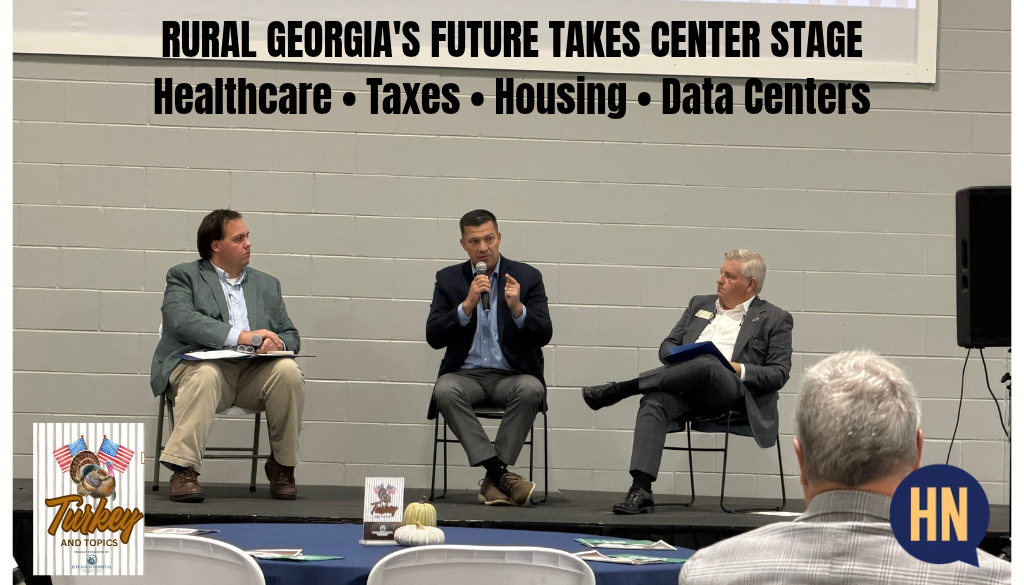
HAZLEHURST, Ga. — November 23, 2026 — Rural healthcare, tax reform, affordable housing and the growing debate over data centers were among the major topics discussed Monday as local business and community leaders gathered for the Turkey and Topics Legislative Preview Luncheon, hosted by the Hazlehurst–Jeff Davis Chamber of Commerce.

Hazlehurst Now attended the event, which featured Senator-elect David Sikes of Senate District 19 and Representative-elect Bradley B. Anderson of House District 157.
The luncheon provided an opportunity for the two incoming lawmakers to share their priorities ahead of Georgia’s 2027 legislative session and answer questions about issues affecting Jeff Davis County and other rural communities.

Oakley G. Perry welcomed attendees and moderated the discussion, which began with opening remarks from both guests before moving into a question-and-answer session.
One of the first topics addressed was the changing political makeup of Georgia’s state government following the November elections. Perry noted that Democrats will control the Georgia House while Republicans will hold a narrow majority in the Senate, creating a different political environment for the upcoming legislative session.
Sikes described the situation as an opportunity for lawmakers from both parties to work together on shared priorities, particularly infrastructure, roads, water and sewer improvements. He emphasized that passing a state budget remains one of the General Assembly’s primary responsibilities and expressed hope that divided leadership could encourage cooperation on issues affecting Georgians across party lines.
Anderson also emphasized the importance of working across political differences while maintaining his conservative principles. He identified rural hospitals, roads, agriculture and education as areas where lawmakers should be able to find common ground.
Both indicated that representing their districts and delivering results would remain priorities regardless of party affiliation.
Healthcare was one of the most significant topics of the luncheon, particularly the financial challenges facing rural hospitals. Perry asked both lawmakers about policies they would support to strengthen rural healthcare facilities, including Jeff Davis Hospital, as Georgia prepares for renewed debate over Medicaid expansion.
Sikes expressed concern about the potential long-term financial obligations associated with expanding Medicaid eligibility.
He discussed the federal government’s current funding arrangement, under which the federal government generally covers 90% of qualifying expansion costs, and questioned whether that level of support would remain in place over time.
Sikes said he would want to examine the projected costs, the state’s financial responsibilities and the reliability of federal funding before supporting a proposal. At the same time, he acknowledged the financial difficulties hospitals face when treating uninsured patients and emphasized the importance of keeping emergency medical care available close to home.
Anderson similarly described rural healthcare as a priority. He pointed to reimbursement rates, workforce recruitment and available funding as areas that deserve attention.
Anderson said he was willing to review Medicaid expansion proposals but wanted to understand their long-term financial implications before committing to a position.
Both lawmakers emphasized that the loss of a rural hospital could have serious consequences for residents who depend on nearby emergency services.
The discussion then turned to proposals to reduce Georgia’s income tax and address property tax burdens. Perry raised a concern particularly relevant to rural counties: how local governments would continue funding schools, roads, public safety and other essential services if property tax revenue were reduced.
Sikes said he supports continued reductions in the state income tax, with the long-term goal of elimination if it can be accomplished responsibly. However, he cautioned that rural counties generally have smaller tax bases than metropolitan communities while still facing substantial public service costs.
Anderson expressed strong support for reducing the state income tax but urged caution when considering state-imposed restrictions on local property taxes.
Drawing on his experience in county government, Sikes emphasized the importance of local control and said county and municipal officials are often in the best position to understand their operating expenses.
He also raised the issue of state tax incentives for data centers, questioning whether large companies should receive substantial tax benefits to locate facilities in Georgia.
The discussion highlighted a central challenge facing state lawmakers: balancing tax relief for residents with the financial needs of local governments.
Housing affordability was another major concern. Perry discussed the difficulty many first-time homebuyers face and the challenges rural communities encounter when trying to attract workers without an adequate supply of affordable housing.
Anderson said housing availability is directly connected to economic development.
He noted that rural builders sometimes face situations in which the cost of constructing a home exceeds its appraised value, making financing and development more difficult.
He expressed interest in targeted incentives, infrastructure assistance and financing programs that could encourage housing construction in smaller communities.
Sikes discussed his previous involvement in a state study of rural workforce housing and described programs designed to help communities cover infrastructure costs for new residential developments.
He also suggested exploring lower-interest financing options to make homeownership more attainable.
Both speakers acknowledged that housing affordability is a significant obstacle for young families and rural communities seeking economic growth.
The final major question focused on Georgia’s increasing electricity demands, particularly those associated with data center development. The discussion was especially timely for Jeff Davis County, where a local Data Center Study Committee recently held its first meeting to examine potential economic, environmental and infrastructure impacts.
Perry also asked whether the authority of the Georgia Public Service Commission should be expanded to regulate electric membership corporations, commonly known as EMCs.
Unlike Georgia Power, EMCs are member-owned cooperatives governed by boards elected by their members.
Anderson expressed reservations about expanding state regulatory authority over EMCs. He said the cooperative model has played an important role in providing electricity to rural communities and emphasized the importance of maintaining local control.
However, he also stressed the need for accountability and transparency, particularly as large industrial electricity users place additional demands on the power system.
Anderson said one of his primary concerns is ensuring that residential customers, farmers and small businesses are not required to absorb costs associated with large data center developments.
Sikes also opposed expanding Public Service Commission oversight of EMCs. He praised the role electric cooperatives have played in serving rural Georgia, including their work restoring electricity following Hurricane Helene.
The discussion then broadened to the potential advantages and disadvantages of data centers. Sikes acknowledged that large facilities can significantly increase a community’s property tax base, potentially providing financial benefits to local governments.
However, he also identified water consumption and the ability of local communities to determine whether they want such developments as important considerations.
He expressed support for allowing local governments and residents to have a meaningful voice in decisions involving data center development.
No specific data center proposal for Jeff Davis County was announced during the luncheon.
As the program concluded, both incoming lawmakers encouraged residents to contact them with questions, concerns and suggestions. Sikes and Anderson emphasized their willingness to hear from constituents as they prepare to begin serving in the Georgia General Assembly.
Perry thanked both guests for participating and announced that the Chamber would recognize their time and service through a donation in their honor to the Jeff Davis County Community Foundation’s community event fund.
He also recognized Chamber supporters, board members, local elected officials and the businesses that helped make the luncheon possible.
Monday’s discussion provided a preview of several issues likely to receive attention when Georgia lawmakers convene in January. For Jeff Davis County, the conversation underscored how decisions made at the state level can affect local hospitals, homeowners, businesses, electric utilities and economic development.
Although the two incoming lawmakers did not offer specific legislative proposals on every issue, both emphasized the importance of understanding the needs of rural communities and maintaining communication with constituents.
Hazlehurst Now will continue following the 2027 legislative session and reporting on developments that affect Hazlehurst, Jeff Davis County and surrounding communities.
