



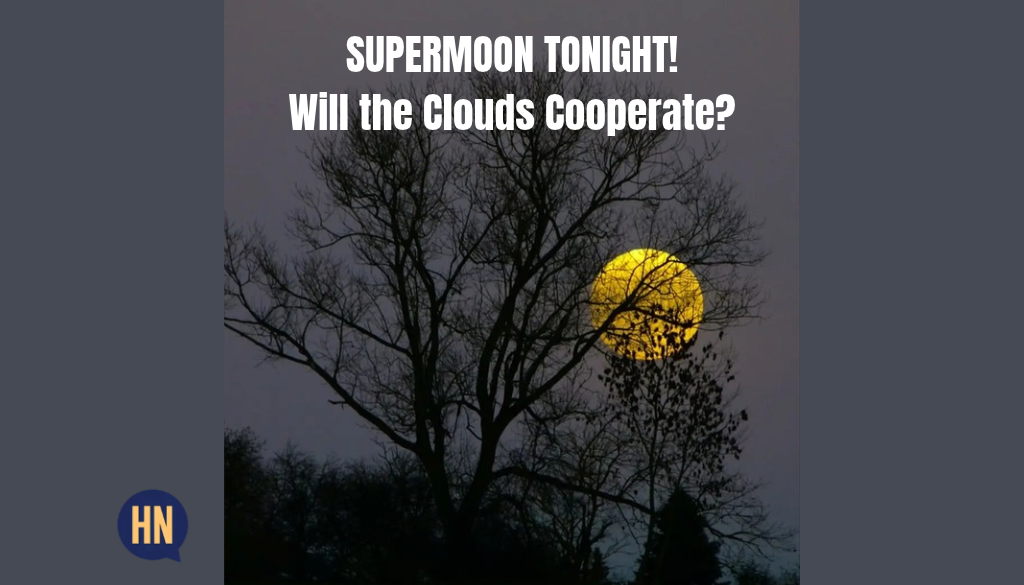
South Georgia residents may want to keep an eye on the night sky this evening as November’s full moon puts on a celestial show just in time for Thanksgiving — if the clouds cooperate.

Known as the Super Beaver Moon, tonight’s moon will appear slightly larger and brighter than an average full moon, marking the beginning of a series of consecutive supermoons stretching into early 2027.
However, cloudy skies across Southeast Georgia could make catching a glimpse of the celestial display challenging.

What Makes a Moon “Super”? The moon does not travel around Earth in a perfect circle. Instead, its orbit is elliptical, meaning its distance from Earth changes throughout the month. When a full moon occurs near its closest approach to Earth, it is commonly referred to as a supermoon.
November’s supermoon is expected to appear approximately 7 percent larger and 11 percent brighter than an average full moon. Although the difference may be subtle, the moon can appear particularly impressive as it rises above the horizon.
November’s full moon is traditionally known as the Beaver Moon, a name associated with the time of year when beavers prepare for the approaching winter. Like many traditional full moon names, it reflects seasonal changes in nature.
November’s celestial event is just the beginning.
Under one commonly used definition, four consecutive supermoons will occur over the coming months:
- November 24, 2026 — Beaver Moon
- December 23, 2026 — Cold Moon
- January 22, 2027 — Wolf Moon
- February 20, 2027 — Snow Moon
NASA identifies three consecutive supermoons through January, while other astronomical sources also include February. The difference comes from varying definitions of how close the moon must be to Earth to qualify as a supermoon.
December’s Cold Moon will be particularly noteworthy, as it will be the closest full moon to Earth in 2026.
Unfortunately, Mother Nature may have other plans for local skywatchers.
The National Weather Service is forecasting cloudy skies across Hazlehurst and Jeff Davis County Tuesday evening, which could make viewing the Super Beaver Moon difficult.
Wednesday evening does not look much more promising, with continued cloud cover and an increasing chance of rain.
However, Thanksgiving evening could offer a better viewing opportunity, with skies expected to become mostly clear for a time. Although the moon will be past its full phase, it will still appear bright and nearly full.
If the clouds briefly break this evening, residents should look toward the eastern horizon around sunset. No telescope or special equipment is necessary to enjoy the supermoon.
An open area with an unobstructed view of the horizon will provide the best viewing opportunity, particularly as the moon begins to rise.
And if Southeast Georgia’s weather prevents us from enjoying tonight’s celestial display, there will be more opportunities in the coming months.
With Thanksgiving just around the corner, the supermoon offers another reason to slow down, step outside with family and appreciate the beauty of the natural world God gave us.
If you’re fortunate enough to capture a photograph of the Super Beaver Moon over Southeast Georgia, we’d love to see it! Share your photos with Hazlehurst Now on Facebook.
Sources: NASA, Smithsonian Magazine, Timeanddate and the National Weather Service.
