



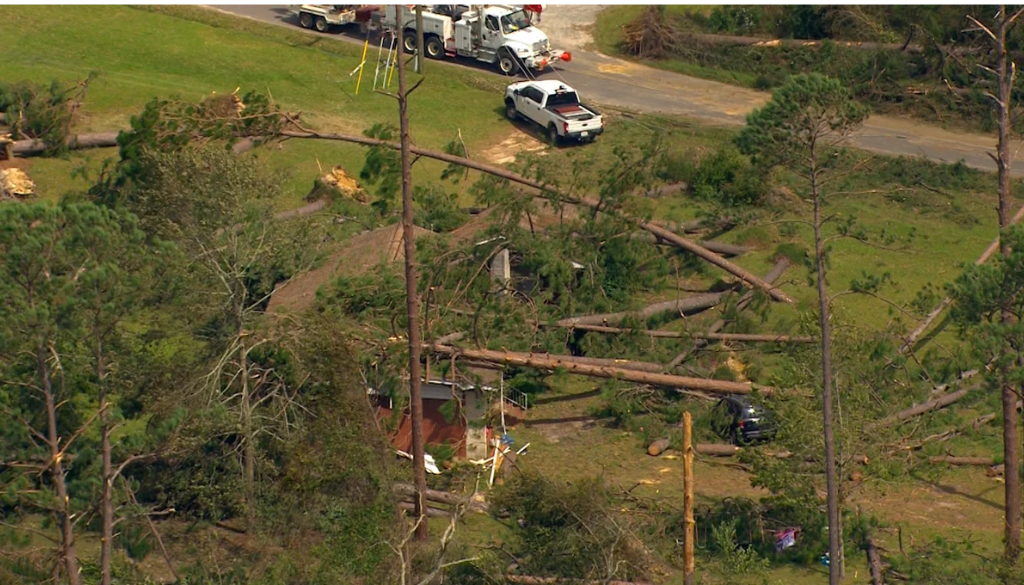
Two years after the historic storm tore through South Georgia, the landscape has changed, some families and farmers are still rebuilding, and the lessons of Helene remain.
Two years ago, Jeff Davis County woke up to a community many residents barely recognized. During the overnight hours of Sept. 26 into Sept. 27, 2024, Hurricane Helene raced north through Georgia after making landfall in Florida’s Big Bend as a powerful Category 4 hurricane. Across Georgia, the storm produced destructive winds, toppled countless trees and power lines and left widespread structural damage in its path. National Weather Service

In Jeff Davis County, the damage was overwhelming. Two years later, most houses have been repaired, roads cleared and power restored. But Helene’s impact didn’t disappear with the debris. It changed farms. It changed forests. It changed livelihoods. And for many families, it changed the way they think about hurricanes forever.
Numbers recorded after the storm help put into perspective what residents saw that morning. UGA Cooperative Extension reports that Jeff Davis County experienced a 100% power outage and loss of cellphone coverage, with some residents remaining without electricity for weeks and cellular service unavailable for several days. Even more staggering: Extension reports that 98% of the county’s roads were impassable following the storm. UGA Extension

Trees and power lines covered roads. Trees fell onto homes. Businesses in Hazlehurst sustained roof and awning damage, while agricultural operations throughout the county suffered devastating losses. WJCL’s aerial survey of Jeff Davis County days afterward showed trees on homes and roofs torn from businesses.
For many residents, the first hours after Helene weren’t about assessing property damage. They were about checking on family, clearing a way out of a driveway or neighborhood and trying to find out whether friends and neighbors were safe.
Perhaps one of Helene’s most lasting visual reminders is what it did to South Georgia’s forests. The Georgia Forestry Commission later determined that Helene crossed 8.9 million acres of Georgia forestland, with approximately 1.47 million acres receiving the majority of the timber damage. The estimated impact to Georgia’s timber resource alone was $1.28 billion. UGA Extension
Across Jeff Davis County, stands of mature pines that had taken decades to grow were snapped or uprooted in a matter of hours. For landowners, those weren’t simply trees. Timber often represents decades of investment and, for some families, retirement income or property intended to be passed to another generation. The scars can still be seen today.
Helene arrived at an especially difficult time for local agriculture — right as peanut harvest was beginning. UGA Extension noted that producers were already dealing with declining commodity prices before the storm added another enormous burden.
Poultry operations were particularly hard hit. Many poultry houses sustained great damage or were completely lost. Birds were also lost when poultry houses collapsed.
Statewide, UGA ultimately estimated approximately $5.58 billion in economic losses to Georgia agriculture and forestry from Helene, including more than $2.6 billion associated with pine and hardwood timber when broader economic impacts were included.
Those statewide numbers were enormous. But in Jeff Davis County, the losses were personal. They represented farms built over generations, income families depended upon and decisions about whether rebuilding even made financial sense.
The scale of cleanup was almost as remarkable as the storm itself. Four months after Helene, Jeff Davis County EMA Director and Fire Chief Charles Wasdin told WTOC that crews had already removed approximately 1.3 million cubic yards of debris — an amount the station described as enough to cover roughly 60 football fields to the height of the goalposts. And there was still more to remove.
Cleanup continued well into 2025. In June 2025, city officials reported that Hazlehurst had received $6.6 million from FEMA related to debris-removal work performed by Phillips & Jordan. Even approaching the first anniversary, county officials were still dealing with Helene-related projects, including clearing waterways clogged by storm debris.
The television cameras eventually moved on. However, Jeff Davis County couldn’t. Nearly a year after Helene, WJCL returned to Hazlehurst and found blue tarps still covering some roofs, debris remaining in places and some homes abandoned. Wasdin summed up the situation simply at the time: “It’s been a long year for us.”
Federal recovery efforts also continued long after the storm. FEMA was still assisting Jeff Davis County applicants in 2025, while the Small Business Administration established a Business Recovery Center at the Jeff Davis Recreation Department to help businesses and nonprofit organizations dealing with physical and economic losses from Helene. FEMA
One year after the storm, WJCL reported an estimated $362 million in local damage in Jeff Davis County and more than $60 million in FEMA assistance. WJCL
The numbers tell the size of the disaster. They don’t tell the entire story of what happened afterward. In the days following Helene, residents checked on neighbors. Churches, businesses, schools and community organizations helped distribute food, water and supplies. Utility workers, first responders, law enforcement officers, road crews, volunteers and people with chainsaws went wherever they were needed.
The Jeff Davis football program was among those helping. GPB reported in October 2024 on coaches and players assisting families while simultaneously dealing with storm damage and hardships of their own. Georgia Public Broadcasting It became a community helping itself while help from outside slowly arrived.
For a while, “Jeff Davis Strong” wasn’t simply a slogan. It described what people were doing.
Today, much of Jeff Davis County looks normal again. But normal isn’t necessarily the same as before. Some farms never returned to the operations they had before Helene. Some timber won’t be replaced for decades. Some buildings were rebuilt; others were not. And some families lost far more than property.
The storm also changed the way many people here view hurricanes. Before Helene, a major hurricane could feel primarily like a coastal concern. Sept. 27, 2024, demonstrated just how much destructive power a tropical system can carry deep into inland South Georgia.
Georgia Power ultimately called Helene the most destructive hurricane in the company’s history, saying portions of the electrical system weren’t simply being repaired after the storm — they essentially had to be rebuilt. Georgia Power
For Jeff Davis County, Helene is now part of the community’s history. There is a before Helene and an after Helene. Two years later, the fallen trees have largely disappeared from the roads. The generators are quiet. Cellphones work. The lights are back on.
But drive through the countryside and look at the broken tree lines. Talk to a farmer who decided not to rebuild. Talk to a family who remembers sitting in the darkness listening to the wind. The reminders are still here. And so is the story of a community that woke up on Sept. 27, 2024, surrounded by destruction — and immediately began helping one another find a way forward.
