



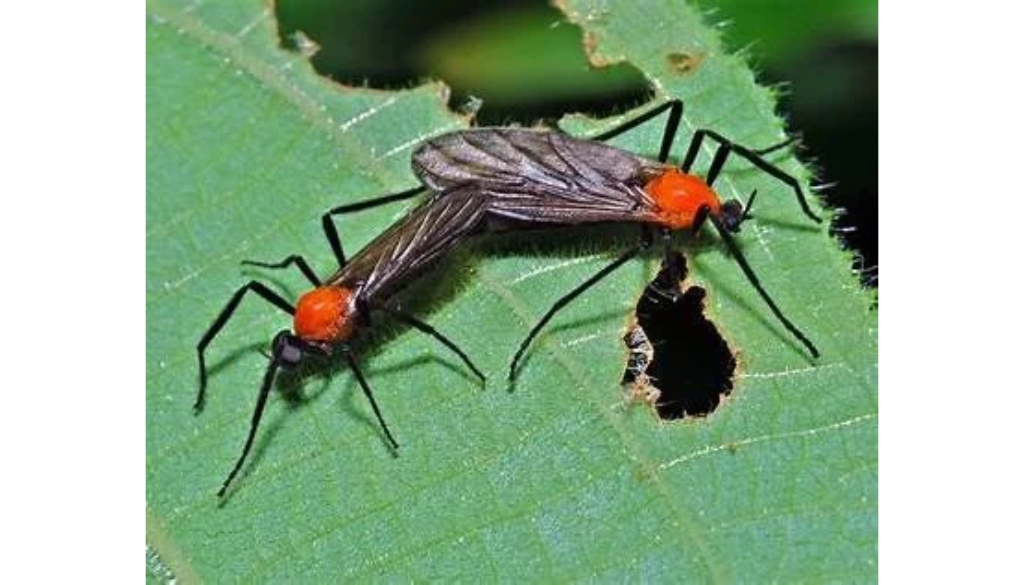
South Georgia’s familiar fall visitors are back — and they seem to be everywhere
If you’ve stepped outside or driven anywhere around South Georgia lately, you probably don’t need anyone to tell you: the lovebugs are back. They’re on vehicles. They’re around yards and businesses. And on some South Georgia roads, drivers are encountering what seems like clouds of them.

So, what exactly are these pesky little insects, and why are we seeing so many of them right now?
First, they’re actually flies! Lovebugs, scientifically known as Plecia nearctica, are a species of fly. Adults are easily recognized by their black bodies, reddish-orange thorax and, of course, their habit of flying around connected in pairs. Those pairs are mating males and females — hence the much sweeter-sounding name “lovebug.”

Despite a long-running Southern legend, lovebugs were not created in a laboratory or genetically engineered and released by the University of Florida. They migrated naturally into the United States and became established along the Gulf Coast and throughout parts of the Southeast. According to University of Florida entomologists, lovebugs are now found throughout Florida and in other states including Georgia, Alabama, Mississippi, Louisiana, South Carolina and Texas.
So, why are they so bad right now? The calendar has a lot to do with it.
Lovebugs typically have two major flights each year, with one occurring during the spring and another in late summer and early fall. That makes September a perfectly normal time for South Georgia to suddenly see large numbers of adult lovebugs.
Most of a lovebug’s life is actually spent out of sight. Females lay their eggs in areas with decaying plant material, and the larvae live in that organic matter, helping break it down. When conditions are right, large numbers reach adulthood around the same time — and suddenly it can seem as though they appeared overnight.
Warm weather also makes a difference. Lovebugs are primarily active during daylight hours, and University of Florida researchers report that flight activity increases when temperatures rise above approximately 82 degrees.
While the current numbers certainly feel unusually high in parts of South Georgia, Hazlehurst Now has not found authoritative data showing that September 2026 represents a record lovebug outbreak. What we’re seeing, however, falls squarely within their normal fall emergence period.
Why do these little fellas seem to love our highways? If you’ve ever wondered why your yard can be relatively peaceful while the front of your vehicle looks like a lovebug graveyard after a highway trip, there’s science behind that, too.
Lovebugs are attracted to certain components associated with vehicle exhaust and are especially active around highways during warm, sunny conditions. University of Florida researchers have documented attraction to irradiated automobile exhaust fumes. Unfortunately, that puts lovebugs and South Georgia motorists on a collision course.
And while the insects themselves are harmless, leaving their remains splattered across a vehicle for an extended period isn’t a good idea. University of Florida guidance recommends soaking affected areas with water for several minutes before gently scrubbing them away; keeping a vehicle waxed can also make removal easier.
Do lovebugs bite? Here’s some good news: No. Lovebugs don’t bite or sting, and they aren’t considered a threat to people or pets. In fact, their larvae serve a useful ecological purpose by helping decompose dead vegetation and returning organic matter to the soil.
Their biggest offense is simply being incredibly annoying — particularly when several hundred decide to introduce themselves to your windshield at 55 miles per hour.
Thankfully, the invasion doesn’t last forever. Individual adult lovebugs have relatively short lives, and the noticeable seasonal flights generally last only a few weeks. As the fall emergence winds down, their numbers should begin dropping again. Until then, South Georgians may want to keep the windshield washer fluid full, wash the front of the vehicle regularly and remember one comforting fact:
Lovebug season will end.
Eventually.
