



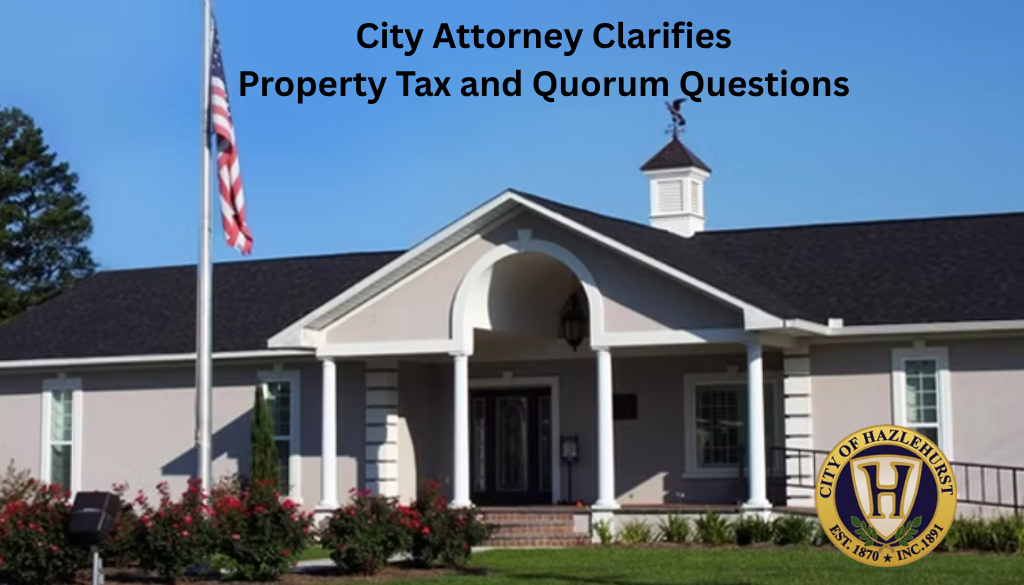
Following recent questions from residents about the city’s property tax rate and how City Council votes are conducted, the City of Hazlehurst has released two statements prepared by its attorneys to help explain the decisions and procedures involved.
The statements address two separate issues: the council’s decision to establish a 7-mill property tax rate and the rules that allow the council to conduct official business when the mayor and only two ward representatives are present.
Both explanations were shared publicly by the city as part of an effort to provide residents with a clearer understanding of local government operations.

Why Did the City Council Choose a 7-Mill Tax Rate?
The Hazlehurst City Council recently voted to establish a property tax rate of 7 mills, an increase from the previous rate of 6 mills.
According to the city’s attorneys, the decision was made after considering current economic conditions and a new state tax-relief program scheduled to take effect January 1, 2027.
The program, established through House Bill 439, is called the Local Homeowner’s Incentive Adjustment Grant Program. It is designed to provide property tax credits to qualifying homeowners with homestead exemptions in eligible cities and counties.
The city’s statement explains that local governments must satisfy certain financial requirements to qualify for the program.
In simplified terms, the attorneys describe two requirements:
- The local government must have collected more revenue than the amount appropriated in its previous year’s budget.
- The revenue estimated for the following year must be at least as much as the revenue actually collected in the previous year.
The attorneys explain that the council considered these requirements when deciding to increase the millage rate.
According to the statement, Hazlehurst’s updated property tax digest showed that keeping the rate at 6 mills would still generate more property tax revenue than originally projected when the city adopted its budget earlier this year.
However, the attorneys say increasing the rate to 7 mills would further assist the city in meeting the financial requirements for the state grant program.
The city’s stated goal is to position Hazlehurst to qualify for a program that could provide property tax relief to eligible homeowners in the future.
What Does That Mean for Property Owners?
A millage rate determines how much property tax is assessed based on a property’s taxable value.
One mill represents $1 in tax for every $1,000 of taxable property value.
For example, on a property with a taxable value of $100,000:
- At 6 mills, the city portion of the property tax would be $600.
- At 7 mills, the city portion would be $700.
That represents a $100 difference in the city tax calculation for that example.
Actual tax bills vary depending on a property’s assessed value, exemptions, and other applicable factors. The city millage rate is also separate from county and school property tax rates.
The city’s attorneys have explained that the increase is intended to help Hazlehurst qualify for the future state tax-relief program.
However, the statement does not establish that every homeowner will receive a tax credit, how much any credit might be, or whether an individual homeowner’s eventual credit would offset the additional city property tax.
The council has established the 7-mill rate, with a separate ordinance vote to formally enact it expected at the next regularly scheduled council meeting in November.
How Can the City Council Vote With Only Three Members Present?
The second statement addresses questions raised by residents about the number of council members required to conduct official city business.
This is known as a quorum.
Simply put, a quorum is the minimum number of members who must be present for a governing body to conduct official business.
Some residents have questioned whether the mayor counts toward that number, particularly when only two ward representatives attend a meeting.
According to the city’s attorneys, the answer is found in the Hazlehurst City Charter, which establishes the rules governing the council.
Section 2.21(a) states that the mayor is considered a council member for purposes of determining a quorum and voting.
Section 2.21(b) establishes that three council members constitute a quorum.
In everyday terms, the city’s attorneys explain that the mayor and two ward representatives are enough to establish a quorum and allow the council to conduct business.
The mayor does not have to be excluded from the count simply because the mayor holds a different elected position from the ward representatives.
What Happens When the Mayor Does Not Cast a Vote?
The city’s attorneys also addressed a related question: What happens when two council members vote in favor of a measure, but the mayor does not cast an affirmative or negative vote?
Under Section 2.21(c) of the City Charter, three affirmative council member votes are required to adopt an ordinance, resolution, or motion.
However, Section 2.21(d) addresses situations in which a member does not vote.
According to the attorneys’ explanation, a council member who does not cast a vote is considered to have agreed with the majority of members who did vote.
The statement cites the October 15, 2026, City Council meeting as an example.
During that meeting, the Ward 1 and Ward 3 representatives voted in favor of a Development Plan Resolution, while the mayor did not cast a vote.
The city’s attorneys explain that, under the charter’s provisions, the mayor’s decision not to vote was treated as concurrence with the two representatives who voted in favor.
Based on that interpretation, the attorneys concluded that the resolution was properly adopted.
The distinction is important: the attorneys are not saying that only two affirmative votes are ordinarily required. They are explaining how the charter treats a member’s decision not to vote when determining the outcome.
The city’s statement applies that explanation to meetings attended by the mayor and two ward representatives when the two representatives vote together and the mayor does not cast a vote.
City Encourages Residents to Ask Questions
Both statements conclude by encouraging residents to attend City Council meetings and ask questions about city operations.
The city says residents who have concerns about the millage rate, the City Charter, or council voting procedures are welcome to bring those questions before the council.
The explanations provide additional context for recent council decisions while also identifying the rules and financial considerations city officials say guided those decisions.
For residents, the two statements address different but important aspects of local government: how the city determines its property tax rate and how elected officials are authorized to conduct city business.
Source: Statements prepared by attorneys for the City of Hazlehurst concerning the 2026–2027 millage rate and Section 2.21 of the City Charter.
