








The debate over data centers is continuing to spread across Southeast Georgia, with local governments considering everything from new ordinances and conditional-use requirements to temporary moratoriums as they try to establish rules before large-scale facilities arrive.


In Jesup, a packed public meeting Tuesday night, Sept. 29, ended with the City Council voting 4-2 to approve the first reading of an ordinance regulating data centers and cryptocurrency operations. The proposed ordinance would define data centers and allow them as a conditional use in light-industrial zoning districts, meaning a data center would not automatically be permitted simply because a property has the appropriate industrial zoning.
Residents who spoke at the meeting raised concerns about water use, electrical demand and other potential impacts. Some urged the city to enact a temporary moratorium instead, allowing additional time to study the issue before permanent regulations are adopted.


The ordinance has not received final approval. Jesup has scheduled a public hearing and proposed final reading for Tuesday, Oct. 6 at 7 p.m. at the Cracker Williams Community Center.
Jeff Davis Taking a Study-First Approach
Here at home, Jeff Davis County is taking a different approach, using a year-long moratorium to give local officials and residents time to study the issue before deciding what regulations may be needed. The Jeff Davis County Board of Commissioners adopted the one-year data center moratorium in May 2026. County Administrator Jayme Crosby said during September’s State of the Community discussion that the county is also working with its attorneys to determine whether additional land-use regulations are needed.
Rather than immediately drafting a data center ordinance, Jeff Davis officials are working with the City of Hazlehurst, City of Denton and Joint Development Authority to form a research committee that will examine both the potential benefits and concerns associated with data center development.
The eventual goal is a public workshop or open forum where residents can hear the committee’s findings and participate in the discussion. No date has yet been announced for that meeting.
That puts Jeff Davis County in a different position from Jesup and Telfair: the county has not yet settled on a proposed data center ordinance. Instead, the moratorium is providing time for research, community involvement and consideration of possible regulations before officials decide what comes next.
Telfair County Completes Third Reading — But Current Draft May Change
Meanwhile, Telfair County has now completed the third public reading of its proposed data center ordinance, but discussion at the latest hearing made clear that adoption of the current version is not certain. No vote was taken during the hearing. Commissioners said the county’s 180-day data center moratorium remains in effect, with the next regular County Commission meeting scheduled for Oct. 20.
The proposed ordinance would apply only to unincorporated Telfair County, not municipalities within the county. Among its provisions are a $15,000 application fee, a $50,000 professional-review escrow, a business-license requirement and a prohibition on tax abatements or incentives. Developers would also be required to hold three public meetings and meet setback, screening and disclosure requirements.
The proposal would prohibit open-loop cooling and primary on-site power generation and require environmental assessments and continued air, water and soil testing. Developers would also be responsible for specialized emergency-response training and equipment.
But much of the latest hearing focused not on whether Telfair County should regulate data centers, but on whether the proposed ordinance is ready. One participant who said she helped develop the ordinance told commissioners she did not want the current version adopted, saying she believes it needs to be strengthened. A commissioner later expressed a similar view, saying, “I don’t want to pass it like it is. I want to fix it. I want to strengthen it.”
Potential Loophole Identified
One of the more significant questions raised during the hearing involved the ordinance’s definition of a data center. The draft discussed at the meeting defines a data center as a facility containing up to 500,000 square feet of gross floor area. A participant questioned whether that wording could unintentionally exclude a single facility larger than 500,000 square feet from the ordinance’s requirements.
After reviewing the language during the meeting, participants acknowledged the wording could represent an oversight. No determination was made that a larger facility would actually be exempt, but the issue was cited as another reason to review the ordinance before adoption.
The proposed 35-decibel noise limit, measured 25 feet from property lines, also generated considerable discussion. Some speakers argued the requirement could be so restrictive that it might expose the county to a legal challenge. That concern was raised during the hearing but was not established as a legal finding.
Telfair County commissioners now face another question: whether to adopt the current ordinance and revise it afterward or use the existing moratorium to continue working on the regulations before adoption. Officials explained that if substantive changes are made, the county would have to go through additional public hearings before adopting a revised ordinance. There was also discussion over the legal strength of the county’s existing moratorium.
An attorney present at the meeting said she believed the current moratorium is effective but cautioned that issues could arise if it were legally challenged. She also indicated that adopting an ordinance and then imposing another moratorium while revisions continue could provide a different legal footing.
The discussion leaves Telfair County with a decision ahead of its Oct. 20 meeting: move forward with the ordinance already through three readings or continue revising it while the moratorium remains in place.
Another important issue emerged during the Telfair hearing: a county ordinance alone would not regulate every potential data center location. Commissioners repeatedly emphasized that the proposed ordinance applies only to unincorporated Telfair County. Municipal governments would have to establish their own regulations.
Residents were also encouraged to pay attention to local development authorities. One commissioner said industries typically make initial contact with a development authority rather than county commissioners and noted the role development authorities can play in economic-development incentives. That means data center policy in the region may ultimately involve not only county commissions but also city governments and development authorities.
Appling County Uses a Moratorium
Appling County has taken another approach, using a temporary moratorium while officials consider how data centers should be regulated.
During a September meeting, commissioners heard public comments both supporting and opposing extending the pause. The chairman of the Appling County Development Authority said at that time that there had been inquiries regarding data centers, but no specific project had been announced.
The approach illustrates one of the central questions now playing out across the region: whether communities should adopt regulations quickly and modify them later or temporarily pause development while more detailed rules are written.
Camden and Glynn Counties Address the Issue
Farther east, the Camden County Board of Commissioners held a special work session Sept. 29 specifically to discuss a data center ordinance.
Glynn County has already incorporated data center requirements into its updated zoning regulations, including provisions addressing cooling systems and potable water use.
The different approaches show there is no single strategy being used across Southeast Georgia.
A Regional Issue
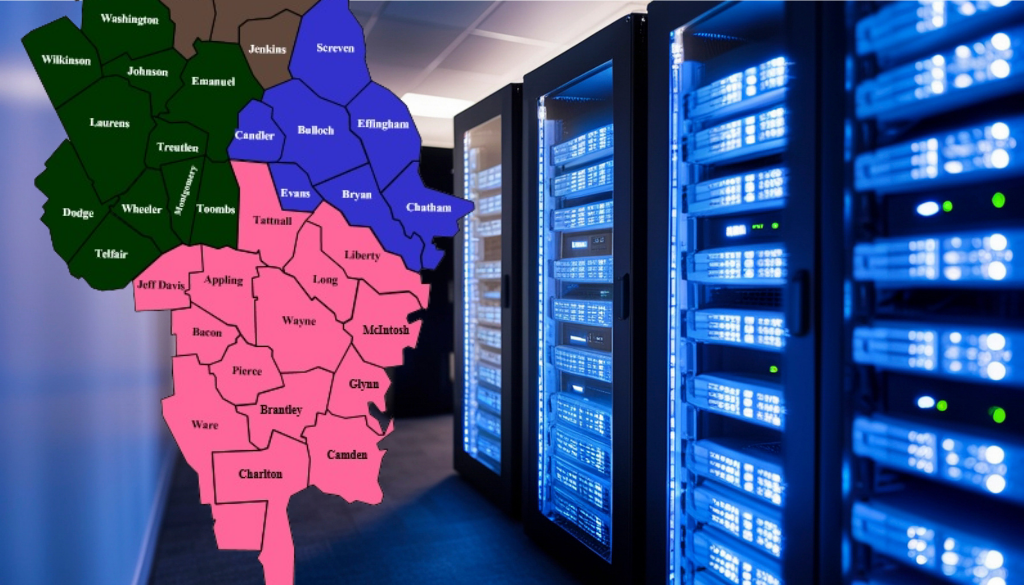
What began as individual discussions in scattered communities is increasingly becoming a regional issue. Jesup is moving an ordinance through the approval process. Telfair County has completed three readings but is debating revisions. Appling County has used a moratorium. Camden County is discussing regulations, while Glynn County has already added data center requirements to its zoning rules.
During the Telfair hearing, Jeff Davis County was even specifically mentioned as one of the neighboring communities believed to be watching what Telfair does. The speaker argued that decisions involving data centers can have effects beyond county lines, particularly when communities share water resources.
For residents of Jeff Davis County and surrounding communities, that makes what happens in Telfair, Jesup and other nearby counties worth watching.
The next two dates could provide additional direction: Jesup’s proposed final reading is Oct. 6, while Telfair County commissioners could decide how to proceed with their ordinance at their Oct. 20 meeting.
Hazlehurst Now will continue following the issue as communities across Southeast Georgia decide what rules they want in place before the next data center proposal arrives.


